Volume 504S, 2026 | IODP³ Expedition 504S: Volcanic ash on the Ontong Java Plateau: testing models of subduction reversal and wind transport in the western equatorial Pacific
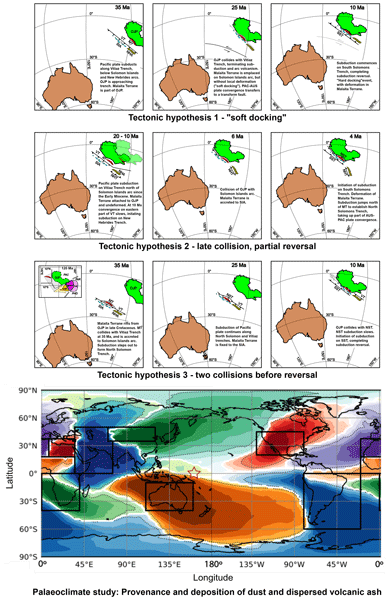
Ontong Java Plateau (OJP) is the largest oceanic plateau on Earth. Collision of OJP with the Solomon Islands arc halted subduction north of the arc, transferring the arc to the Pacific plate and initiating subduction on the southern side of the arc. The OJP–Solomons collision is regarded as the textbook example of subduction reversal. However, competing hypotheses for the collision invoke major differences in the timing and nature of events, with significant implications for modelling of the subduction reversal process.
Previous scientific drilling recovered cores at multiple sites on OJP. The Eocene to Miocene sequence in these cores hosts multiple volcanic ash layers, as well as numerous cryptotephras, disseminated ash, and aeolian sediments. The occurrence of these ashes has been interpreted to reflect proximity of OJP to the arc, but this has not been tested geochemically, and the ashes may represent arc, hot-spot, or mixed sources. International Ocean Drilling Programme (IODP3) Expedition 504S will analyse the ashes, cryptotephras, and aeolian materials. Determination of the provenance of the ashes will allow a test of competing subduction-reversal scenarios. Knowledge of the ash sources will also provide new constraints on wind strength and direction in the equatorial Pacific during the late Eocene to early Miocene, spanning the strengthening of the East Asian Monsoon. Cryptotephras and aeolian sediments will contribute supporting evidence of wind system reorganisation over this time.
This volume of the Proceedings of the International Ocean Drilling Programme includes the Scientific Prospectus and scientific results of IODP3 Expedition 504S.
Volume 504S, 2026 | IODP³ Expedition 504S: Volcanic ash on the Ontong Java Plateau: testing models of subduction reversal and wind transport in the western equatorial Pacific
Ontong Java Plateau (OJP) is the largest oceanic plateau on Earth. Collision of OJP with the Solomon Islands arc halted subduction north of the arc, transferring the arc to the Pacific plate and initiating subduction on the southern side of the arc. The OJP–Solomons collision is regarded as the textbook example of subduction reversal. However, competing hypotheses for the collision invoke major differences in the timing and nature of events, with significant implications for modelling of the subduction reversal process.
Previous scientific drilling recovered cores at multiple sites on OJP. The Eocene to Miocene sequence in these cores hosts multiple volcanic ash layers, as well as numerous cryptotephras, disseminated ash, and aeolian sediments. The occurrence of these ashes has been interpreted to reflect proximity of OJP to the arc, but this has not been tested geochemically, and the ashes may represent arc, hot-spot, or mixed sources. International Ocean Drilling Programme (IODP3) Expedition 504S will analyse the ashes, cryptotephras, and aeolian materials. Determination of the provenance of the ashes will allow a test of competing subduction-reversal scenarios. Knowledge of the ash sources will also provide new constraints on wind strength and direction in the equatorial Pacific during the late Eocene to early Miocene, spanning the strengthening of the East Asian Monsoon. Cryptotephras and aeolian sediments will contribute supporting evidence of wind system reorganisation over this time.
This volume of the Proceedings of the International Ocean Drilling Programme includes the Scientific Prospectus and scientific results of IODP3 Expedition 504S.