
the Creative Commons Attribution 4.0 License.
the Creative Commons Attribution 4.0 License.
 | 22 Jul 2026
IODP3 Expedition 505S “ENIGMA: ExploratioN Into a Global early Miocene Anomaly” Scientific Prospectus
Adam Woodhouse
Jennifer Kasbohm
The early Miocene (23–17 Ma) is emerging as a potentially transformative time in marine ecosystems. A lack of sampling in the early Miocene, relative stability in the genus-level richness of traditionally studied marine fossils (e.g. shallow-water hard-shelled invertebrates), and no record of perturbation(s) in traditional climate proxies such as benthic foraminifera-derived carbon and oxygen isotope ratios have led to an assumption that the early Miocene was relatively uneventful climatically. Growing evidence suggests otherwise; recently published high-resolution marine microfossil, phylogenetic, and geochemical records have revealed that the early Miocene was a time of significant ecological upheaval that led to permanent changes in marine ecosystem structure and function at a scale not observed since the Cretaceous–Paleogene Mass Extinction. Reconstructed early Miocene biotic changes spanned trophic levels from primary producers to top predators, impacting diatoms, foraminifera, reef fish, and whales, alongside other marine taxa. Specifically, open-ocean sharks were heavily impacted, suffering the largest extinction event known in their 400-million-year history, corresponding with a global disruptive event in planktonic foraminifera community composition. Though a clear environmental driver for these ecological changes is not yet known, the upheaval observed in marine biota coincides with an abrupt shift in foraminifera-bound nitrogen isotopes, signifying a change in ocean oxygenation or nutrient cycling. Together, these records suggest that the potentially rapid changes in biodiversity and marine community structure during the early Miocene were profound and may have laid the foundation for the ocean ecosystem structure observed from the later Miocene to present day. In this SPARC, we will explore the biotic and environmental changes that occurred during this critical and understudied interval in Earth's history. Spanning the breadth of the Atlantic Ocean and the Caribbean Sea, we will employ a multi- and inter-disciplinary approach to refine age models, collect new geochemical proxy data, and perform Earth system model simulations to assess the basin-wide response across preserved trophic levels to early Miocene ecosystem perturbation. ENIGMA aims for a spatiotemporally complete documentation of the ecological and environmental response of an entire ocean basin to disentangle this enigmatic Earth system change.
- Article
(6025 KB) - Full-text XML
-
Supplement
(1125 KB) - BibTeX
- EndNote


The Miocene Epoch, 23.03–5.33 million years ago (Ma), was a period of extensive climate change as Earth transitioned from the relative warmth of the Paleogene Greenhouse World to the Icehouse World of the Pliocene–Pleistocene. The Miocene is typified by changes in Antarctic ice sheets (AISs) and overall global cooling and marks the establishment of near-modern flora and fauna, both on land and in the oceans (Steinthorsdottir et al., 2021). Miocene researchers have traditionally focused on (1) the Miocene Climate Optimum (MCO, ∼ 17–14.7 Ma) because it may serve as a possible analogue for our future, warmer world (e.g. Steinthorsdottir et al., 2021) or (2) its aftermath, the Middle Miocene Climate Transition (∼ 14.7–13.8 Ma) and the Late Miocene cooling events (7–5.5 Ma), which led to the evolution of our current bipolar glaciated climate (e.g. Boscolo-Galazzo et al., 2021; Herbert et al., 2016; Woodhouse and Swain et al., 2023). As a result, there are relatively few global climate and biotic records documenting the portion of the early Miocene that precedes the MCO. Our understanding of the earlier Miocene world is therefore rather weak, with mainly low-resolution geochemical records compared to other intervals of climatic perturbation (Miller et al., 1985, 1991; Miller and Katz, 1987; Westerhold et al., 2020; Woodruff and Savin, 1989; Zachos et al., 2001), though higher-resolution records do exist (e.g. Liebrand et al., 2016, 2017). Recent work shows that this largely overlooked interval may contain at least one abrupt ecological turnover (Sibert and Rubin, 2021). But the causal mechanism and accompanying changes in the Earth system that impacted the biosphere during the early Miocene currently remain unquantified.
Few paleontologists have scrutinized the early Miocene interval from 23 to 17 Ma as traditional genus-richness-based metrics do not indicate major biotic change during this interval (e.g. Sepkoski, 2002). However, in recent years, multiple works by ENIGMA co-proponents have shown critical biodiversity and ecological changes in at least two different taxonomic groups with extremely different ecological roles: sharks (Sibert and Rubin, 2021) and planktonic foraminifera (Swain and Woodhouse et al., 2024). These investigations highlight the interval around 19 Ma as a major biotic transition in the ocean, unique in magnitude for the entire Cenozoic (66–0 Ma), with changes spanning trophic levels from phytoplankton to apex predators (Fig. 1). Namely, Sibert and Rubin (2021) identified a major extinction in sharks, with > 70 % reduction in the morphological diversity of dermal denticles in pelagic sediments and > 90 % reduction in accumulation, concomitant with a permanent transition in marine vertebrate community structure (Sibert et al., 2016), as well as global radiations and adaptations in cetaceans (Dominici et al., 2020; Marx et al., 2019; Rule et al., 2023) and reef fishes (Brownstein et al., 2025). Furthermore, coeval substantial shifts have been reconstructed in the community structure and diversity of planktonic foraminifera (Fenton and Woodhouse et al., 2021; Swain and Woodhouse et al., 2024), diatoms (Lowery et al., 2020; Spencer-Cervato, 1999), ostracods (e.g. in the Indo-Australian Archipelago; Tian et al., 2024), bryozoa (e.g. in the Caribbean; Di Martino et al., 2018), radiolaria (Kamikuri et al., 2005), and deep-sea mussels (Miyazaki et al., 2010).
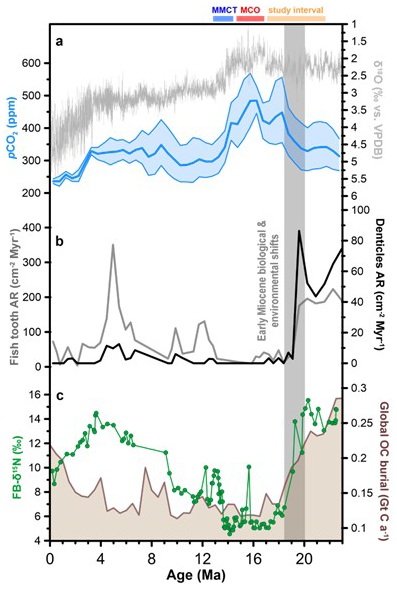
Figure 1(a) Benthic δ18O composite by Westerhold et al. (2020) in grey and atmospheric CO2 concentration based on multiple CO2 proxies compiled by the Cenozoic CO2 Proxy Integration Project (Hönisch et al., 2023) in blue. (b) Shark and fish accumulation rates (ARs) from Sibert and Rubin (2021). (c) Foraminifera-bound nitrogen isotopes (FB-δ15N) from ODP Site 872 (Auderset et al., 2022, green), modelled global organic carbon (OC) burial rates in gigatons carbon per year (Gt C a−1) (Li et al., 2023, brown). MCO: Miocene Climate Optimum; MMCT: Middle Miocene Climate Transition. The vertical grey bar indicates major biological and environmental shifts around the early Miocene (∼ 19 Ma) interval.
Environmental changes including changes in nutrient cycling, oxygenation perturbations, and changes in AIS volume and deep-ocean circulation (Li et al., 2023; Smart and Murray, 1994; Smart and Thomas, 2006, 2007) accompany these biological shifts around 19 Ma. The ∼ 19 Ma interval also coincides with a 0.5 ‰ increase in benthic foraminiferal δ18O in Southern Ocean records (Atlantic and Indian Ocean sectors), which could indicate deep-water cooling and/or AIS growth (Cramer et al., 2009). Outside of the signal noted in the Southern Ocean, there is a general lack of stable isotopic evidence of a global climate perturbation at this time (Westerhold et al., 2020).
Important tectonic events such as the first restriction of the Indonesian Seaway between southeastern Asia and Australia (∼ 22 Ma, Hall, 2009), the final closure of the Tethys Seaway (∼ 19 Ma; Harzhauser et al., 2007; Yasuhara et al., 2020; Zammit et al., 2022), and opening and deepening of the Fram Strait throughout the Miocene in the North Atlantic (∼ 17 Ma; Ehlers and Jokat, 2013; Wright et al., 1992) could have altered global ocean circulation and triggered some of the observed environmental and biotic changes. Additionally, changes in the Drake Passage in the early Miocene may have affected conditions in the Atlantic basin (Lagabrielle et al., 2009; van de Lagemaat et al., 2021). However, the ultimate driver of these changes remains elusive. The modelling community has not yet extensively targeted the early Miocene, focusing instead on well-documented periods like the MCO or the late Miocene (see Burls et al., 2021, for a review). There are notable early attempts to understand the Oligocene–Miocene transition (von der Heydt and Dijkstra, 2006), as well as more recent attempts to understand broad changes in the global meridional overturning circulation through the early–middle Miocene (Naik et al., 2025). This lack of modelling effort is compounded by the paucity of environmental records, contributing to the poor understanding of climate system behaviour and associated forcing during this time period.
We suggest that the early Miocene interval from 23 to 17 Ma represents an ideal case study within which to investigate the basin-scale environmental and ecological response of components preserved within marine sediment cores. Microfossil records including material representing multiple trophic levels spanning primary producers (e.g. diatoms, coccolithophores) to apex predators (e.g. fish and sharks or ichthyoliths) are abundantly preserved in these cores. In particular, the enigmatic nature of these clustered biotic, oceanographic, and tectonic changes will require the compilation and acquisition of paleoceanographic and biologic proxy data preserved in scientific ocean-drilling material. Integrating these data with Earth system models will establish an ongoing data–model comparison protocol (e.g. Zhang et al. 2025) to better understand how trophic interactions could have been altered (e.g. Woodhouse et al., 2024), thereby setting the stage for the evolution of the modern marine biosphere.
ENIGMA seeks to develop, correlate, and investigate relatively complete records of life and environmental conditions in the deep sea during the early Miocene (23–17 Ma) using sediment cores collected through past scientific ocean drilling. Lower Miocene sedimentary records have long been noted as incomplete, with more than one hiatus confirmed or proposed to occur between 20 and 18 Ma (Barron and Keller, 1982; Keller and Barron, 1983; Kennett, 1977; Miller et al., 1985, 1991; Dutkiewicz and Müller, 2022). An extensive preliminary investigation by ENIGMA team members found that, of the 1264 scientific ocean-drilling sites sampled by the International Ocean Discovery Program (IODP) and its predecessors (1968–2024), only 683 extended deeper than the early Miocene, and 140 of those sites were sampled with coring too patchy to determine the completeness of early Miocene sediments. Of the remaining 543 sites, 85 % have a likely or confirmed early Miocene hiatus, with only 15 % containing likely complete sections (Sibert and Rubin, 2021; Figs. 2A and 3). Notably, the hiatuses we have identified may be true gaps in sedimentation; artefacts of drilling such as spot-coring, more typical of earlier drilling legs; or incomplete recovery due to lithological changes (e.g. Evans, 2020). Dutkiewicz and Müller et al. (2022) also highlight the prevalence of hiatuses in Lower Miocene sediments, particularly in the Atlantic, which they suggest is connected to the complete opening of the deep Drake Passage, the gradual closure of the Tethys Seaway, and therefore the initiation of a proto-Atlantic Meridional Overturning Circulation. With these changes, along with the fact that the Atlantic sector offers numerous sites with complete packages of Lower Miocene sediments, it is the region most likely to capture a basin-wide ecosystem response (Fig. 2).
Targeted legacy materials (detailed in Sect. 4.1 and Table S1 in the Supplement) allow us to examine changes across both hemispheres, spanning tropical to high-latitude temperate zones, oceanographic regimes including coastal margins and subtropical gyres (Fig. 3), and sites influenced by deep-water formation in the North Atlantic and along the Antarctic continental margin. Moreover, many legacy sites, such as those on Ceara Rise (ODP Leg 154), have undergone extensive X-ray fluorescence (XRF) scanning (Fig. 3) and are perhaps the most well-constrained continuous sedimentological records that have been chronologically tuned to orbital cyclicity (e.g. Shackleton et al., 1999). The robust age models for and decades of prior research into many of our chosen legacy sites (see Supplement) lay a strong foundation for new records of sedimentological and biological dynamics. Future work prompted by this SPARC project could expand to high-latitude locations and other ocean basins, such as sites within the Pacific and Indian oceans (Fig. 2), to further refine our understanding of the early Miocene interval around 19 Ma.
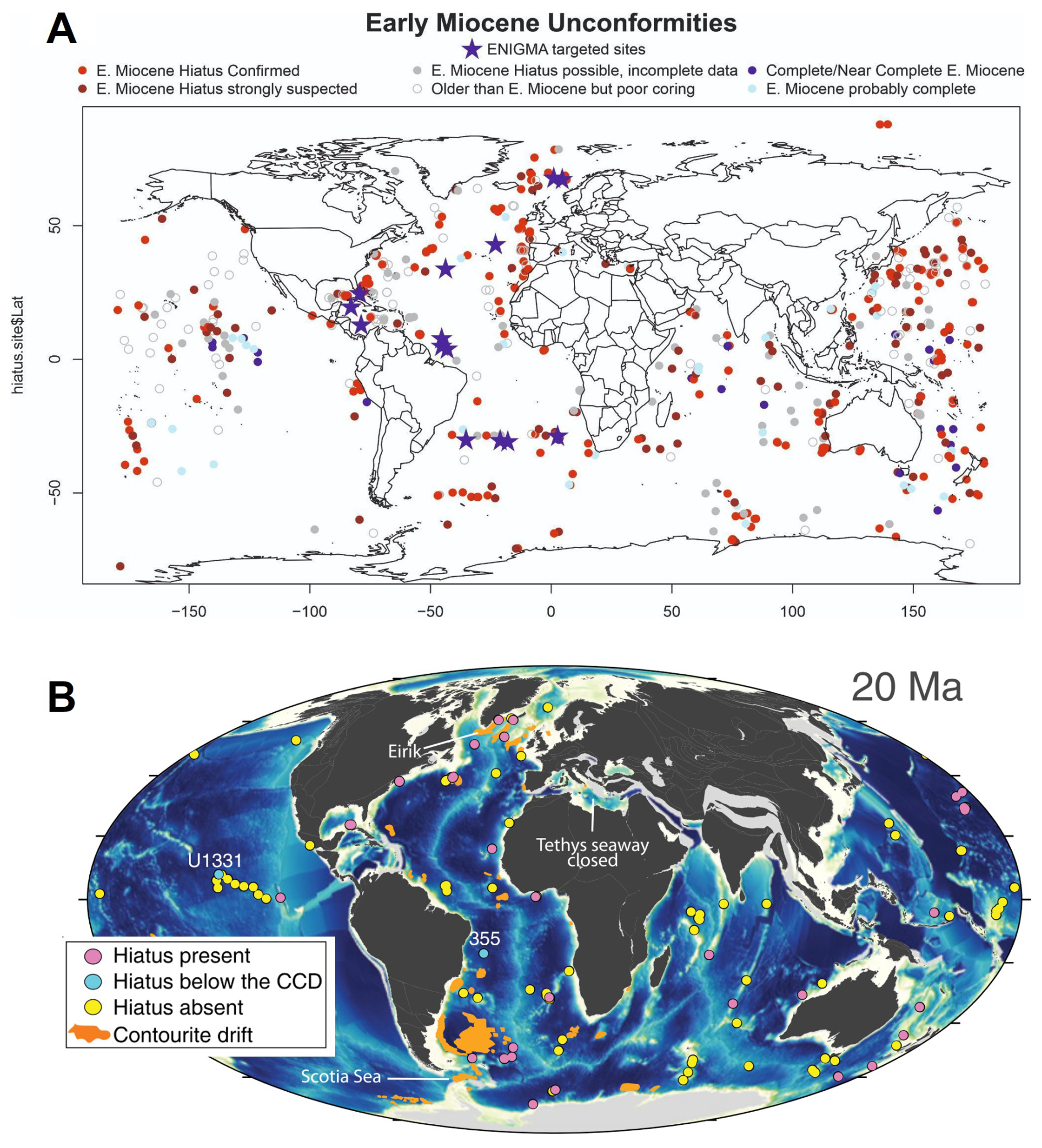
Figure 2(A) Global distribution of scientific ocean-drilling sites covering the early Miocene interval (23–17 Ma). Colour coding marked on the figure denotes the stratigraphic completeness of each section. Dark-blue stars indicate ENIGMA target sites with complete or near-complete early Miocene (23–17 Ma) sections. Light-blue stars indicate potential future targeted sites with probably complete early Miocene sections. Figure modified after Sibert and Rubin (2021). (B) Map of hiatuses at 20 Ma and localities of contourite drifts from Dutkiewicz and Müller (2022).
ENIGMA will quantify environmental and ecosystem changes of the early Miocene (focusing on the interval from ∼ 23 to 17 Ma) and the role such changes played in the evolution of the modern biosphere. We seek to test the hypothesis that tectonically driven palaeoceanographic changes during the early Miocene altered primary productivity and nutrient export, the geochemical and micropaleontological signals of which will have been preserved in marine sediments.
The project will take a holistic approach, using multiple proxies on selected legacy deep-sea sediment cores to apply a novel framework for reconstructing ancient ecosystem change designed for maximum scientific utilization of marine sediment samples (Woodhouse et al., 2024). The data generated through ENIGMA will explore existing Earth system and geodynamic modelling scenarios and feed into the generation of new models throughout the lifespan of the project. We will address our hypothesis by investigating the following scientific objectives (SOs):
-
SO1. We will refine chrono-stratigraphic age models of all studied records to assess synchroneity of oceanographic and biotic changes during the early Miocene. Assessing whether early Miocene environmental changes occurred synchronously or not depends on the generation of accurate and precise age models for all sites, anchored by numerical ages (Westerhold et al., 2024). We will take a uniform approach to refine age models for each of our target sites by refining shipboard chrono-stratigraphic protocols at a higher resolution and utilizing high-precision radioisotopic geochronology wherever possible. We therefore seek applicants with expertise in age model development and/or reconciliation using stratigraphic correlation through bio-, chemo-, and magneto-stratigraphy, as well as geochronology and astrochronology.
-
SO2. We will generate and synthesize records of early Miocene environmental change across the Atlantic Ocean. We will use a suite of qualitative and quantitative geochemical and sedimentological proxies to assess climatic and environmental changes during the early Miocene (Table 1). We therefore seek applicants with expertise in XRF data collection, processing, and interpretation and in a wide suite of geochemical analyses covering temperature, CO2, productivity, oxygenation, and surface to deep-water mass properties. XRF data will be integrated into other non-destructive techniques such as high-resolution core imaging and gamma-ray attenuation porosity evaluator (GRAPE) measurements to allow for better appraisal of environmental change and core splicing of composite sections.
-
SO3. We will generate records of early Miocene biotic change. Existing legacy publications and database compilations of fossil assemblage data will be supplemented by new data collected from ENIGMA from all present microfossil groups throughout the Atlantic Ocean target sections. We therefore seek applicants with experience and expertise in the collection of scientific ocean-drilling micropaleontological data (including planktonic foraminifera, calcareous nannoplankton, radiolaria, ichthyoliths, ostracods, and palynology). For all SOs, shared sample splits will maximize the scientific outputs of sediment sampling.
-
SO4. We will assess the collective response of marine organisms to environmental changes using ecologically motivated statistical and mechanistic models. With the collected environmental and ecosystem data, we will integrate ecological and evolutionary modelling alongside climate records (e.g. implement the Micropaleoecology Framework as described in Woodhouse et al., 2024) to determine how the holistic marine ecosystem of the Atlantic Ocean responded to early Miocene paleoenvironmental shifts. ENIGMA will benefit substantially from Science Team members with experience in ecosystem modelling and integrated microfossil analyses.
-
SO5. We will develop model simulations to investigate ocean evolution during the early Miocene and assess forcing factors. We welcome applicants who can collaborate to implement a marine biogeochemistry-enabled Earth system model to simulate the response of climate–ocean dynamics, as well as productivity and dissolved oxygen, to a variety of orbital and climate system forcings that could have influenced the biotic and abiotic changes documented around 19 Ma. We will refine or adapt the modelling framework during the course of the ENIGMA project as more data become available. Our simulations will help clarify our mechanistic understanding of early Miocene global ocean and biotic evolution.
As we pursue each of these scientific objectives, we will provide training to the next generation of scientific ocean-drilling scientists while paying special attention to the inclusion of scientists with identities historically excluded from STEM and shipboard activities.
ENIGMA is designed to addresses key Strategic Objectives, Flagship Initiatives, and Enabling Elements laid out in the 2050 Science Framework:
Strategic Objective 1 – Habitability and Life on Earth. ENIGMA will quantify environmental changes and biotic responses across a previously understudied but evolutionarily important interval in geologic time that may have driven major changes in the habitability of marine ecosystems. Science objectives (SOs) 2–4 seek to analyse how marine trophic webs responded to abiotic changes by quantitatively assessing links between paleoenvironmental and paleobiological records using advanced statistical techniques.
Strategic Objective 3 – Earth's Climate System. We will take a multi-proxy approach to reconstruct past climate conditions during this interval to better constrain Earth's climate system and explore the interactions between climate and biological response. This approach will include stable carbon and oxygen isotopic records from benthic foraminifera to assess bottom water temperature and ice volume and will help with orbital tuning at the sites through our study interval. For SOs 1–2, we will use existing and collect new sedimentary XRF data (Fig. 3) to develop age models for our sites and to track redox and productivity changes across this interval. These efforts will support direct comparisons of trans-Atlantic environmental and biotic signals, which will inform model outputs in SO5.
Strategic Objective 4 – Feedbacks in the Earth System. The data generated for SOs 2 and 5 will address the role of tectonically driven feedbacks (e.g. closure of the Indonesian Seaway between southeastern Asia and Australia (∼ 22 Ma), the Tethys Seaway (∼ 19 Ma), and the Fram Strait (∼ 17 Ma)) alongside possible nuanced cryosphere-driven feedbacks by testing the strength of the biological pump throughout the Atlantic Ocean. Changes in organic carbon burial will also provide critical information on the possible role of biologically driven feedback. The broad spatial distribution and variable proximity to coastlines of our sample sites will help determine the possible role of terrestrial vs. marine system feedbacks (Fig. 3).
Strategic Objective 5 – Tipping Points in Earth's History. Early Miocene biotic turnover suggests that a tipping point was reached in the biological system and possibly the Earth system as a whole. The apparent lack of climatic tipping points suggested by traditional geochemical data (e.g. stable carbon and oxygen isotope excursions or shifts) in early Miocene global climate records presents a conundrum, although changes in nitrogen isotopes at this interval (Auderset et al., 2022) hint at the fact that more recently developed techniques may tell a different story. Collectively, SOs 1–5 signify a unique opportunity to investigate the drivers, scales, and rates of the ∼ 19 Ma global abiotic and biotic disruption and quantify the biotic and abiotic resilience and recovery on an ocean basin scale.
Flagship Initiative 1 – Ground-Truthing Future Climate Change. Today's climate and biotic crises are restructuring global marine trophic systems (Bach et al., 2016; Baum et al., 2023; Spisla et al., 2021). The ENIGMA study interval is unique in its observable characteristics in comparison with intervals that have been targeted as analogue climate states (e.g. Mid-Piacenzian Warm Period, Miocene Climatic Optimum, Early Eocene Climatic Optimum, Paleocene–Eocene Thermal Maximum; Tierney et al., 2020) and therefore may contain potential consequences of anthropogenic climate forcing that are yet to be ground-truthed and/or identified. Of particular interest is the staggering detriment to marine vertebrates quantified by Sibert et al. (2016) and Sibert and Rubin (2021). Today, marine vertebrates and, especially, sharks are dealing with the impacts of a changing climate (increased temperature, ocean acidification, marine anoxia) in addition to factors that are uniquely caused by humans (harvesting, overfishing; Dillon and Pimiento, 2025; Dulvy et al., 2021; Pimiento et al., 2023; Yasuhara et al., 2024; Yasuhara and Deutsch, 2022). SOs 2–4 are specifically designed to reconstruct environmental variables and investigate how the marine ecosystem responded to such changes, thereby potentially providing important insights into marine plankton community response to abiotic perturbations.
Flagship Initiative 4 – Diagnosing Ocean Health. Recent work has shed light on mechanisms of ocean oxygenation through geological time and the potential implications of anthropogenic climate forcing on ocean health in the near-future (Auderset et al., 2022; Doney et al., 2020; Moretti et al., 2024). These studies focussed on geological intervals that are example test beds for climate change scenarios (Early Eocene, Middle Miocene, Paleocene–Eocene Thermal Maximum; Auderset et al., 2022; Hess et al., 2023; Moretti et al., 2024). SOs 1–2 will expand on these prior studies by exploring the early Miocene interval, where substantial changes in foraminifera-bound nitrogen isotopes suggest a contraction of the largest contemporary oxygen-minimum zone alongside a large-scale reduction in primary productivity and carbon burial (Fig. 1). SO2 will also address this Flagship Initiative by providing data on the spatial dynamics of bottom water ventilation, redox conditions, and nutrient availability in the ocean. In particular, our site coverage and sampling strategy will capture productivity in coastal to deep-marine regions, in tropical to high-temperate latitudes, and across gyres (Fig. 3), culminating in an ocean-wide dynamics dataset for marine primary productivity and bottom water mass behaviour.
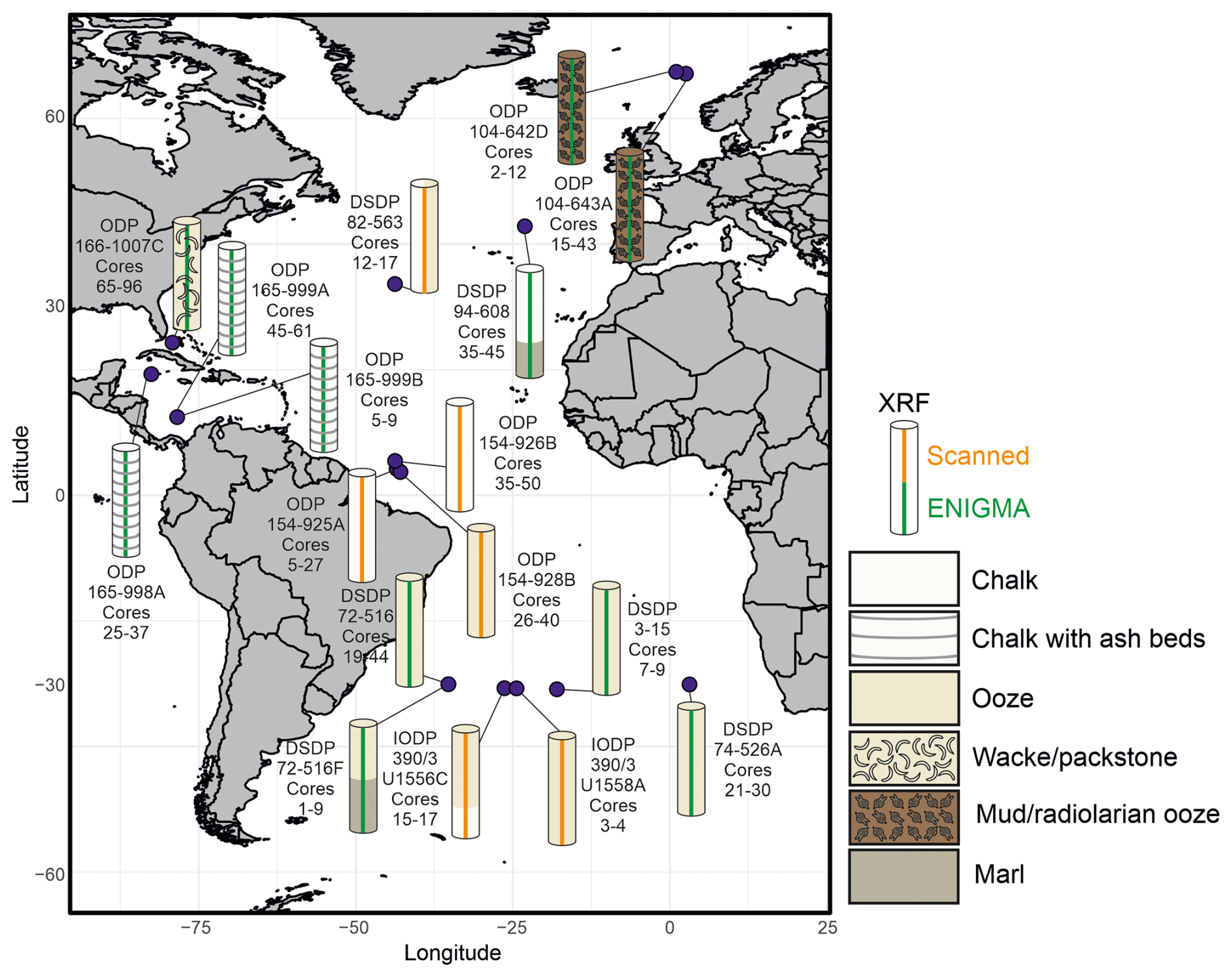
Figure 3Scientific ocean-drilling sites with complete or near-complete early Miocene sections that will be targeted by the ENIGMA Science Team. Core descriptions include the leg, site, hole, and target cores for all assessed material. Colours indicate general lithology (see key) of study sections, and coloured bars indicate the sections of the core which have already been analysed via XRF (red) and those that we plan to analyse for ENIGMA (green).
Enabling Element 1 – Broader Impacts and Outreach. ENIGMA seeks to train the next generation of scientific ocean-drilling scientists to be skilled in data generation and interpretation, wrangling, management, and harmonization through working closely with other scientists who are well-versed in such skills. In addition, the entire Expedition Science Team will be trained in community engagement and science communication.
The impact of scientific ocean drilling – Improving climate models, assessing future ocean health. Scientific ocean-drilling data provide crucial information for understanding Earth's past climate and ecological conditions. This knowledge is essential for building accurate climate models and predicting future ocean health by allowing for enhanced predictive models that simulate the complex interactions between species and their environment. By studying how marine ecosystems responded to past environmental shifts, like those in the early Miocene, we can better anticipate how they might react to current and future changes.
Inspiring educators and the public through discovery. We will communicate the research undertaken by ENIGMA to the public and local communities. UK-based proponents will use university open days and National Fossil and Nature festivals to broadcast research findings to the public and prospective students utilizing scientific ocean-drilling samples and outreach resources (e.g. 3D-prints of microfossils). We will upload the data generated by ENIGMA to online, open-access databases, which will benefit both researchers in the field and educators. As data generated from such studies are not always friendly for K-12 (US), primary and secondary (UK), and elementary to high school (Japan) educators to incorporate into their classrooms, the research team will develop educational activities using our data. These educational modules will be developed in a way that learners can discover the patterns of species' diversification and the abiotic drivers that led to such patterns. Social media (e.g. Instagram, TikTok, BlueSky; Facebook promotions keep people in the social media ecosystem but do not encourage outside engagement; Lundgren et al., 2024) will be leveraged to disseminate research in a digestible format for the general public. ENIGMA co-proponents have substantial collective experience in outreach and research dissemination; however, we plan to include a science communicator as a key component of the Science Team to lead this aspect of the project through the SPARC's duration.
Training the next generation of scientists. With the non-renewal of the R/V JOIDES Resolution and the subsequent reduction in opportunities to sail on scientific ocean-drilling expeditions, it is critical that we continue to train the next generation of scientific ocean-drilling scientists (Harper et al., 2024). SPARCs such as ENIGMA represents an opportunity to do just that by having graduate students, postdocs, and pre-tenure faculty mentored by the co-proponents in scientific ocean-drilling research. The proponent team and collaborators in the Early Miocene Working Group (see the Acknowledgements) have separately studied paleoceanography, paleoclimatology, geochronology, paleobiology, evolutionary biology, sedimentology, and Miocene climate and ocean dynamics; as such, we are collectively well-versed to ensure a holistic research experience for the Science Team. The co-proponents will also introduce members of the SPARC Expedition Science Team to their respective international networks including MioOcean, the Early Miocene Working Group, and the Time Integrated Matrix for Earth Sciences (TIMES; Westerhold et al., 2024).
International collaboration and advancing diversity and inclusion. Our primary goal is to create a diverse, international Expedition Science Team composed of scientists with complementary skills and an interest in long-term collaborations. The fact that our research will not be conducted at sea will empower scientists with disabilities who were excluded from sailing to participate in land-based expeditions. Some Science Team members may not be native English speakers, and this strength will be leveraged to disseminate our research in multilingual formats where possible. Furthermore, we will encourage ENIGMA's Science Team during and after the sampling party to engage in exchange programmes offered by team members, with a focus on students and early-career researchers (ECRs). This exchange will strengthen our network and encourage knowledge-sharing across diverse fields, future-proofing scientific ocean drilling for the next generation of scientists.
Knowledge sharing. ENIGMA seeks to promote open-access efforts and mitigate the legacy of scientific colonialism (Smith et al., 2024). All further data and methods from ENIGMA will be published on open-access data servers (PANGAEA or Zenodo) and journals that have no citation limit or limit on the number of authors. This is specifically important for projects like ENIGMA that will ultimately extract data from hundreds of articles and researchers, all of which should be cited for their efforts.
Engaging with other fields. As a truly interdisciplinary project, ENIGMA will depend on the sharing of knowledge and skills through the active collaboration of individuals from diverse academic backgrounds. We will prioritize the selection of participants who have skillsets different from those of the co-proponents so that we can continue to learn from one another.
Enabling Element 4 – Technology Development and Big Data Analytics. ENIGMA involves the development of a comprehensive biological and environmental database of early Miocene records, similar to earlier works by ENIGMA co-proponents (Fenton and Woodhouse et al., 2021; Sibert and Rubin, 2021; Swain and Woodhouse et al., 2024). The SPARC Expedition Science Team will also lead the development and adaptation of quantitative tools for analysing the database. These tools encompass network analysis, statistical learning, causal inference, and spatial occurrence modelling (e.g. Antell et al., 2024; Fagan et al., 2022; Smith et al., 2023; Staples et al., 2025; Swain and Woodhouse et al., 2024). Our codes and analytical tools will be made publicly available through open-access repositories. Furthermore, the project will use the quantitative data-based results to build mechanistic models, particularly environmentally coupled dynamic food web and Earth system models. We will thereby create the first harmonized and comprehensive assessment of Miocene records, fostering community engagement and empowering researchers by providing open-access data and analytical tools to use in their own research.
4.1 Targeted legacy resources
ENIGMA will tentatively target 15 sites in the Atlantic Ocean basin that contain complete or nearly complete early Miocene sections (Fig. 3) and that are distributed such that they will capture a range in sea surface temperatures and primary productivity. We plan to XRF scan ∼ 1095.33 m in total, across the 15 sites, and, depending on the conditions of older legacy cores, we will perform new high-resolution core imaging. The following is a description of existing information from each site and opportunities for ENIGMA work. Existing analyses are detailed in Table S1.
4.1.1 DSDP Leg 3 Site 15
Deep Sea Drilling Program (DSDP) Site 15, located in the subtropical South Atlantic, contains a condensed (18 m) early Miocene interval through Cores 7–9, obtained through rotary drilling. However, slumping and/or drilling issues caused a repeated section to be drilled in Core 9 (Maxwell et al., 1970). Recovery in Cores 7 and 8 was good (94.4 %), and shipboard and post-cruise bio-stratigraphy documented well-preserved planktonic foraminiferal and calcareous nannofossil assemblages (Blow, 1970; Bukry and Bramlette, 1970; Maxwell et al., 1970). Leg 3 was the first opportunity for the DSDP to assess paleomagnetic stratigraphy for parts of the Lower Miocene, Upper Oligocene, and Cretaceous–Palaeogene boundary (Henry and Opdyke, 1970), and ENIGMA may be able to better refine this stratigraphy.
4.1.2 DSDP Leg 72 Site 516
The southwestern Atlantic DSDP Site 516 contains a moderately expanded (172.9 m) early Miocene composite section within Holes 516 (obtained through hydraulic piston coring) and 516F (obtained through rotary drilling), with moderate recovery (Hole 516 = 87.8 %, Hole 516F = 74.2 %). Previous bio-stratigraphic and assemblage work has assessed ostracods (Benson and Peypouquet, 1983), calcareous nannofossils (Berggren et al., 1983b; Gennari et al., 2018; Persico and Villa, 2013; Plancq et al., 2012), diatoms (Gombos, 1983), radiolaria (Johnson, 1983), planktonic foraminifera (Berggren et al., 1983b; Gennari et al., 2018; Pujol, 1983; Spezzaferri and Pearson, 2009), and benthic foraminifera (Tjalsma, 1983). Newer magneto-stratigraphic data have constrained prior biochronology between 23 and 22 Ma in Hole 516F (Berggren et al., 1983b, a; Florindo et al., 2015; Gennari et al., 2018); ENIGMA should further update this analysis. Low-resolution (Hess et al., 1989) and oxygen and carbon isotope (Pagani et al., 2000a; Woodruff and Savin, 1989) stratigraphy has also been explored, with both benthic and planktonic species analysed in the latter to assess water column gradients (Pagani et al., 2000a). Co-proponent Auderset analysed foraminifera-bound (FB)-δ15N at a low resolution (200 kyr) during the study interval (Auderset et al., 2022), which will be bolstered by the ENIGMA Science Team. Multiple studies have also assessed organic chemical components including organic matter provenance (Dequadros et al., 1983), total organic carbon, n-alkanes, and alkenones (Pagani et al., 2000b, a; Plancq et al., 2012).
4.1.3 DSDP Leg 74 Site 526
DSDP Site 526, obtained by hydraulic piston coring in the southeastern Atlantic Ocean, exhibits the highest core recovery for the early Miocene interval in the prospective ENIGMA sites, with 109 % recovery owing to core expansion within the 44 m interval (Moore et al., 1984). Shipboard and post-cruise microfossil studies produced diverse calcareous assemblages of benthic and planktonic foraminifera (Boersma, 1984b, a), calcareous nannofossils (Jiang and Gartner, 1984), and calcareous dinoflagellates (Futterer, 1984). Sedimentation rates appear to be relatively low during the study interval despite the consistently high CaCO3 % in sediments (Shackleton, 1984), and a low-resolution oxygen and carbon isotope analysis confirms the presence of benthic taxa, allowing for a high-resolution stable isotope record through ENIGMA (Shackleton et al., 1984; Woodruff and Savin, 1989). No Miocene sea surface temperature (SST) records currently exist for DSDP Site 526, highlighting another gap in Atlantic climate reconstructions that ENIGMA aims to address.
4.1.4 DSDP Leg 82 Site 563
Located in the subtropical–temperate North Atlantic, DSDP Site 563 yielded a well-recovered (90.3 %) 57 m long early Miocene sedimentary section, obtained by rotary drilling. Numerous microfossil studies focused on calcareous nannoplankton (Albasrawi, 2016; Bukry, 1985; Maiorano and Monechi, 1997, 1998; Miller et al., 1985; Parker et al., 1985; Peleo-Alampay and Wei, 1995), ostracods (Coles and Whatley, 1989; Whatley and Coles, 1991), planktonic foraminifera (Echols, 1985; Miller et al., 1985; Smart and Murray, 1994; Smart and Thomas, 2006, 2007), and benthic foraminifera (Katz et al., 2003; Miller and Katz, 1987). Integrated bio-stratigraphic, magneto-stratigraphic, and stable isotopic (δ18O, δ13C, ) studies suggest the entirety of the nannofossil zone NN3 (18.28–17.95 Ma) of Martini (1971) to be missing due to an unconformity (Abreu and Haddad, 1999; Hess et al., 1989; Khan et al., 1985; Miller et al., 1985, 1987; Miller and Fairbanks, 1983; Peleo-Alampay and Wei, 1995; Wright et al., 1992). The confirmation of a minor < 1 Myr hiatus permits us to use Site 563 as a control site to test whether other sites exhibit unconformities at similar horizons not identified in previous work.
4.1.5 DSDP Leg 94 Site 608
DSDP Site 608 is located in the temperate North Atlantic; cores span the early Miocene through to the modern (26 Ma–present) with moderate recovery (85.5 %) of a 106 m cored interval obtained through variable-length hydraulic piston coring with an extended core barrel. Microfossil assemblage studies showcase lower-diversity calcareous taxa (diatoms, calcareous nannoplankton, planktonic foraminifera, benthic foraminifera) more typical of mid- to high-latitude regions (Baldauf et al., 1987; Gartner, 1992; Hayward et al., 2010; Jenkins, 1987; Knappertsbusch, 2000; Miller et al., 1991; Plancq et al., 2012; Smart and Murray, 1994; Smart and Thomas, 2006, 2007; Spiegler and Muller, 1992; Takayama and Sato, 1987; Thomas, 1986a, b, 1987), including enigmatic groups such as bolboformids (Spiegler and Muller, 1992), with multiple records correlated to the geomagnetic polarity timescale (Baldauf et al., 1987). Researchers have developed a low-resolution integrated δ18O, δ13C, , bio- and magneto-stratigraphic age model to establish Site 608 as a Miocene isotope reference section (Miller et al., 1991; Takahashi, 2004; Wright et al., 1992). This age model suggests that the entirety of Chron C6A is missing (21.083–20.040 Ma) due to an unconformity. ENIGMA will build upon the firm foundation provided by these studies as the Science Team will update previous records and apply novel methodologies at a higher resolution. Alongside a well-constrained chronology, Site 608 has been the subject of significant biomarker work (Pagani et al., 2000a), where recent studies suggest possible large-scale swings in CO2 and/or changing nutrient availability between 19.5–17 Ma (Super et al., 2018, 2020). These changes co-occur with a possibly Atlantic-wide bloom in opportunistic biserial planktonic foraminifera from ∼ 18.9 to 17.2 Ma, possibly linked to a basin-wide nutrient regime change (Smart and Murray, 1994; Smart and Thomas, 2006, 2007) that we plan to examine in more detail through ENIGMA.
4.1.6 ODP Leg 104 Hole 642D
Hole 642D yields a well-recovered (91 %) high-latitude 106.3 m section primarily composed of mud and radiolarian ooze obtained with an extended core barrel. It is one of the two selected high-latitude sites. Microfossil studies have characterized assemblages of agglutinated benthic foraminifera (Goll, 1989; Osterman and Qvale, 1989); dinoflagellates (Goll, 1989; Manum et al., 1989); and multiple siliceous groups including radiolaria (Goll and Bjørklund, 1989), silicoflagellates, ebridians, and actiniscidians (Ciesielski et al., 1989; Goll, 1989; Locker and Martini, 1989). Paleomagnetic studies produced a well-preserved magneto-stratigraphic sequence through the early Miocene interval (Bleil, 1989), in agreement with sporadic dates (Smalley et al., 1989), and the presence of tephras through the study interval (Bitschene et al., 1989; Despraires et al., 1989; Taylor and Morton, 1989) hold potential for further constraining our ENIGMA age model with high-precision U–Pb zircon geochronology (e.g. Kasbohm et al., 2024).
4.1.7 ODP Leg 104 Hole 643A
Hole 643A, located proximally to Hole 642D, contains a more expanded (281.2 m) section with comparatively poorer recovery (65.9 %) of similar lithological makeup, obtained through hydraulic piston coring with an extended core barrel. Similar microfossil groups to Hole 642D are present at Hole 643A (Ciesielski et al., 1989; Eldholm et al., 1987; Goll, 1989; Goll and Bjørklund, 1989; Manum et al., 1989; Osterman and Qvale, 1989; Sliwinska et al., 2014). The oldest paleomagnetic reversal identified is the C5Dr.2r/C5En boundary (18.056 Ma) at ∼ 255.7 m b.s.f. (Bleil, 1989), and there may be potential to extend this further with the ENIGMA Science Team and integrate with zircon geochronology from ash layers (Bitschene et al., 1989). Sedimentological (Froget et al., 1989; Hempel et al., 1989; Henrich et al., 1989; Krissek, 1989) and organic geochemical (McDonald et al., 1989) studies have been performed on cores from both selected ODP Leg 104 sites and will help disentangle our planned XRF and organic biomarker data generation to factor in the influences of sedimentological, volcanogenic, and biological inputs through the study sections from both sites.
4.1.8 ODP Leg 154 Hole 925A
Studying three sites within close proximity on Ceara Rise (Sites 925, 926, and 928) will allow us to assess the consistency of any paleoecological and paleoceanographic patterns that may be detected on a local scale alongside the basinal scale of the Atlantic Ocean. Tropical Atlantic ODP Site 925 rotary cored an expanded (221.5 m) early Miocene section with moderate recovery (74.6 %). Shipboard and post-cruise calcareous nannofossil and planktonic and benthic foraminiferal bio-stratigraphic work reveals typical low-latitude assemblages across Ceara Rise (Curry et al., 1995; Guitián et al., 2020; Pearson and Chaisson, 1997; Winter and Pearson, 2001), where reticulofenestrid coccolith sizes exhibit increases after ∼ 21 Ma (Guitián et al., 2020). Magnetic susceptibility (Weedon, 1997) and sedimentological (Diester-Haass et al., 2009; Dobson et al., 2001) studies, alongside inorganic δ44Ca (Sime et al., 2007), δ26Mg (Higgins and Schrag, 2010), Nd (van Soelen et al., 2017; Zhang, 2020), and organic (Ohkouchi and Wada, 1997; van Soelen et al., 2017; Zhang et al., 2013) geochemical data, yield substantial environmental data on Site 925 and across Ceara Rise sites.
4.1.9 ODP Leg 154 Hole 926B
The early Miocene interval at Hole 926B had higher recovery (91.8 %) than the Site 925 section through a 173.4 m section drilled with an extended core barrel. Post-cruise microfossil surveys have studied calcareous nannofossils (Bergen et al., 2017; Boesiger et al., 2017; Curry et al., 1995; De Kaenel et al., 2017; Raffi et al., 2016), planktonic foraminifera (Curry et al., 1995; Fraass et al., 2019), and benthic foraminifera (Diester-Haass et al., 2011) in a more detailed manner. Multiple geochemical system studies have focussed on Site 926, including (Billups et al., 2004), δ11B (Greenop et al., 2019; Sosdian et al., 2018), planktonic foraminifera δ18O and δ13C (Paul et al., 2000; Pearson et al., 1997), and Nd (Stewart et al., 2016). There are many investigations of a range of inorganic trace element ratios and concentrations (Mawbey and Lear, 2013; Stewart et al., 2017; Weedon and Shackleton, 1997; Zhang, 2020).
4.1.10 ODP Leg 154 Hole 928B
At Hole 928B, coring with an extended barrel recovered 82.1 % of the 144.2 m Lower Miocene sediments on Ceara Rise. Low-resolution (∼ 1.5 m) planktonic foraminiferal (Curry et al., 1995; Pearson and Chaisson, 1997) and calcareous nannofossil (3–7 m) bio-stratigraphy has been undertaken, alongside some inorganic chemical work (Zhang, 2020). All of the selected Leg 154 holes for ENIGMA (925A, 926B, 928B) were immediately recognized for their importance in cyclo-stratigraphy and paleoceanography when initially cored and have subsequently been heavily sampled for δ18O and δ13C stable isotope stratigraphy (Cramer et al., 2009; Diester-Haass et al., 2009; Pälike et al., 2006; Paul et al., 2000; Zachos et al., 2001), stratigraphy (Flower et al., 1997; Martin et al., 1999), and δ7Li stratigraphy (Misra and Froelich, 2012). Furthermore, cores from all selected sites have been fully XRF-scanned, allowing them to be readily integrated and studied for the context of ENIGMA.
4.1.11 ODP Leg 165 Hole 998A
Located in the Caribbean, Hole 998A exhibited poor recovery (∼ 62 %) of the 125 m thick Lower Miocene sedimentary interval obtained with an extended core barrel. There have been numerous studies of calcareous microfossil groups (calcareous nannofossils, planktonic and benthic foraminifera; Clark and Totten, 2024; Kameo and Bralower, 2000; Sigurdsson et al., 1997), and magneto-stratigraphy shows good agreement with bio-stratigraphic datums (Louvel and Galbrun, 2000). Calcareous nannofossils suggest a shift from eutrophic to oligotrophic systems from ∼ 19.2 to 17.65 Ma (Clark and Totten, 2024). In addition to a low-resolution δ18O and δ13C stable isotope stratigraphy (Clark and Totten, 2024), some Nd data also exist for Site 998 (Newkirk and Martin, 2009). Abundant tephra is present throughout the core (Carey and Sigurdsson, 2000; Peters et al., 2000; Scudder et al., 2016), providing ENIGMA an opportunity to better constrain the age model through high-precision U–Pb zircon geochronology (e.g. Kasbohm et al., 2024).
4.1.12 ODP Leg 165 Holes 999A and 999B composite
The other Caribbean ENIGMA target site is the composite section of Site 999 Holes A and B, obtained through coring with an extended barrel and rotary drilling, respectively. Recovery was moderate to good, with Hole 999A recovery (78.3 %) being poorer than 999B (91.1 %) over the 163.6 and 38.5 m of the cored study interval, respectively. Micropaleontology work at Site 999 targeted calcareous nannofossils (Kameo and Bralower, 2000; Mejía-Molina et al., 2010; Sigurdsson et al., 1997), as well as planktonic (Chaisson and D'Hondt, 2000; Sigurdsson et al., 1997) and benthic foraminifera (Sigurdsson et al., 1997). A low-resolution bulk δ18O and δ13C stable isotope stratigraphy was developed at Site 999 (Mutti, 2000; Mutti et al., 2005), and tephras will allow ENIGMA to develop an age model derived from high-precision U–Pb zircon geochronology that bolsters regional correlation with Site 998 and Site 1000 (Kasbohm et al., 2024).
4.1.13 ODP Leg 166 Hole 1007C
The western North Atlantic margin Site 1007 yielded a highly expanded (308.2 m) core with poor recovery (64.5 %) due to rotary drilling, made up of shallow-water wacke and/or packstone. In addition to shipboard nannofossil, planktonic, and benthic foraminiferal bio-stratigraphy (Eberli et al., 1997), post-cruise work has refined the planktonic foraminiferal chronology (Wright and Kroon, 2000) and characterized palynological assemblages present within the region (Paez-Reyes and Head, 2013; Verhoeven et al., 2014). Bulk and foraminiferal δ18O and δ13C stable isotope studies were performed at a low resolution (Frank, 2000; Swart and Eberli, 2005) alongside geochemical studies on Li (Dellinger et al., 2020), other trace elements (De Carlo and Kramer, 2000; Frank, 2000), and chemistry of interstitial waters (Kramer et al., 2000). No Miocene SST data exist for Site 1007 sediments.
4.1.14 IODP Expeditions 390 and 393 Hole U1556C
At South Atlantic Hole U1556C, the 28.5 m early Miocene sequence exhibited complete recovery (104.4 %) using a half-length advanced piston corer and an extended core barrel. Calcareous nannofossil and planktonic and benthic foraminiferal assemblages are present within carbonate-rich intervals (Coggon et al., 2024), which post-cruise XRF work revealed to be the primary lithology within the ENIGMA sampling interval (Wang et al., 2024).
4.1.15 IODP Expeditions 390 and 393 Hole U1558A
The other South Atlantic Hole U1558A also yielded complete recovery (101.9 %) of a 19 m early Miocene section using the half-length advanced piston corer. Calcareous microfossils were present consistently throughout the study interval (Teagle et al., 2024), and high-resolution XRF work has been performed post-cruise (Villa et al., 2024).
4.2 Sampling and data sharing strategy
All applicants applying for membership of the SPARC Expedition Science Team should refer to the Sample, Data, and Obligations Policy (https://iodp3.org/documents/sample-data-obligations-policy/, last access: 7 March 2026). This document outlines the policy for distributing scientific ocean-drilling samples and data to research scientists, curators, and educators. The document also defines the obligations that recipients of samples and data incur. The SPARC co-chief scientists, in discussion with the curators of the core repositories, will work with the entire SPARC Expedition Science Team to develop a formal implementation plan once the team is assembled following the open call for participation. The implementation plan will include the following:
-
detailed plans for collaboration between SPARC Expedition Science Team members and how this will be facilitated and managed to promote focused research and progress (e.g. plans for in-person sampling at the core repositories, frequency of dedicated virtual and in-person meetings of the Science Team), as well as how results will be disseminated;
-
outline discussions held with the curators of the core repositories regarding the availability of core materials and plans for accessing and using repository facilities;
-
plans for obtaining additional funding to complete the research if this cannot be achieved using the EUR 300 000 SPARC award;
-
a Gantt chart showing the timelines for the research, as well as key milestones and deliverables.
Every member of the SPARC Expedition Science Team will be obligated to carry out scientific research for the expedition and publish the results by contributing to the production of the SPARC Expedition summary and results in the Proceedings of the International Ocean Drilling Programme and by publishing in other scientific journals. All SPARC Expedition Science Team members are required to submit their own detailed research plans and associated sample/data requests via the Sample, Data, and Research Request Manager (SDRM) system (https://web.iodp.tamu.edu/SDRM/#/, last access: 7 March 2026) in order to receive samples to work on. However, sample requests must be provided to the SPARC Expedition co-chief scientists prior to submission to allow them to coordinate sampling efforts, avoid duplications and resolve sampling conflicts between Science Team members. However, subsequent sharing of allocated samples between SPARC Expedition Science Team members to facilitate integrated analyses will be encouraged.
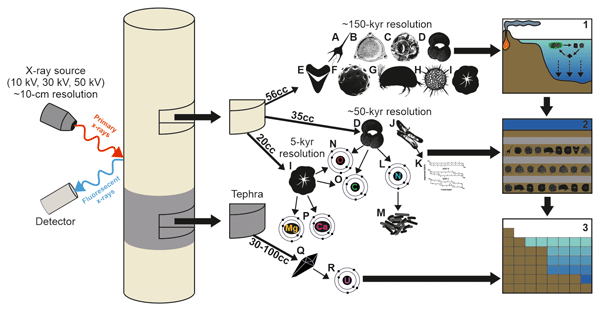
We plan to implement a systematic research strategy to document the ecosystem and environmental changes associated with the early Miocene study interval, ultimately leading to application of the Micropaleoecology Framework (Woodhouse et al., 2024). This framework is a novel approach highlighting the incomparable utility of marine sediments collected through scientific ocean drilling to study how entire ecosystems respond to environmental change. Marine sediments record abiotic (elemental, geochemical, lithological) and biotic (biomarkers; molecular, body, or trace fossils) ecosystem components, which represent the interactions of organisms from across the entire trophic continuum (from primary producers (e.g. coccolithophores) to apex predators (e.g. ichthyoliths)) and can thus be leveraged through mechanistic models and system-level statistical analyses to assess how trophic conditions have changed through time (Fig. 4). The application of such a framework is perfectly suited for the large, interdisciplinary, and international team of a SPARC as each component of the framework relies on an expert who is able to develop a high-quality and high-resolution dataset of a specific paleoproxy, microfossil group, geochronological methodology, or data-processing technique (Fig. 4). Thus, a coordinated sampling effort will allow for dozens of independent proxy-, fossil-, or site-specific projects that will then come together in a coordinated whole to explore the early Miocene of the Atlantic Ocean.
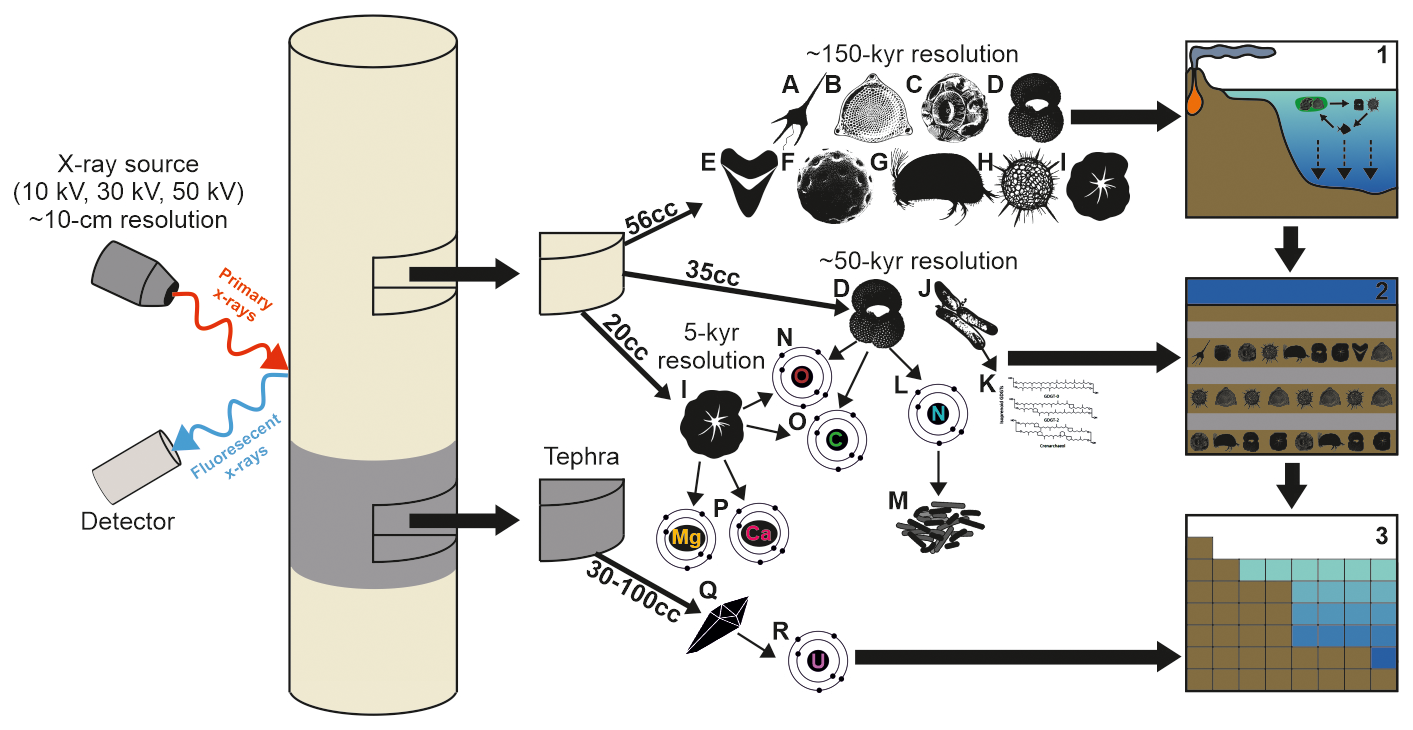
Figure 4ENIGMA sampling strategy to maximize scientific results from legacy scientific ocean-drilling samples. A: dinoflagellates; B: diatoms; C: nannofossils; D: planktonic foraminifera; E: ichthyoliths; F: pollen; G: ostracods; H: radiolaria; I: benthic foraminifera; J: Archeae; K: GDGTs; L: FB-δ15N; M: denitrifying bacteria; N: δ18O; O: δ13C; P: ; Q: zircons; R: U–Pb geochronology; 1: in situ early Miocene Earth system with abiotic and biotic components that are transported to the seafloor; 2:subseafloor stratigraphy preserving ecosystem sampled by scientific ocean drilling; 3: Earth system model generated through integrated abiotic and biotic data preserved in early Miocene marine sediments.
To maximize the scientific results of the expedition, we have formulated a methodology that promotes sample sharing whilst avoiding depletion of the archive material stored in the scientific ocean-drilling repositories (Fig. 4), allowing for further analysis by future generations of scientific ocean-drilling researchers. For ENIGMA, we plan to perform a full suite of microfossil analyses (analysis of all possible micropaleontological components present within a sample) at ∼ 150 kyr resolution (∼ 40 samples per site) across all selected sites, where 56 cc of material will be required; 25 cc is ample material for calcareous microfossil (planktonic and benthic foraminiferal, ostracod) analysis, which can be shared for ichthyolith sampling, whilst palynological analyses require a minimum of 20 cc (Riding, 2021). Calcareous nannofossil analysis will require 1 cc. Finally, silicofossil analysis requires 10 cc of total sediment. At selected sites, a ∼ 50 kyr resolution (∼ 120 samples per selected site) analysis of 35 cc of sediment will be performed with a focus on organic biomarker analysis (15 cc) and foraminiferal geochemical analyses (20 cc). The focus of the latter foraminiferal data is to (1) generate a planktonic foraminiferal FB-δ15N record through the Atlantic Basin and (2) generate paired planktonic and benthic foraminiferal δ13C and δ18O records, where δ13C will allow for an assessment of Atlantic basin-wide vertical water column carbon isotope gradients and biological pump efficiency and δ18O will permit tracking of oceanographic fronts. We will perform these analyses on well-preserved specimens within the Trilobatus trilobus plexus, Paragloborotalia spp., and Cibicidoides mundulus, representing the surface mixed-layer, thermocline, and bottom waters, respectively. At other selected sites (see Table 1), we will perform high-resolution (∼ 5 kyr, ∼ 1200 sample per selected site) benthic foraminiferal stable δ13C and δ18O isotope analyses to allow us to tune certain ENIGMA sites to the same chronology across the Atlantic Ocean. This will be paired with benthic foraminiferal trace element analysis for select sites (see Table 1), allowing for the disentanglement of the bottom water temperature signal from the ice volume component of the δ18O signal. For this analysis, we will request 20 cc per sample, and where all higher-resolution analyses intersect with lower-resolution sampling methodologies, samples will be shared. The final analyses that require sediment core sampling are discrete intervals of volcanic tephra that are present in ODP Leg 104 and 165 sites. Here, we require 30–100 cc of material to perform geochronological analyses to improve age constraints across the Caribbean and Nordic Sea regions. Finally, ENIGMA seeks to perform XRF analyses on all unscanned core material selected for sampling at ∼ 10 cm resolution at 10, 30, and 50 kV excitation frequencies (Fig. 4). Non-destructive legacy records will be collated alongside data generated by ENIGMA, allowing for a concerted effort to splice together high-resolution imagery, gamma-ray attenuation porosity evaluator (GRAPE), and XRF count data to better constrain our environmental interpretations and produce a resource for future workers. Depending on SPARC Expedition Science Team post-expedition objectives, this sampling strategy will be adjusted.
Our coordination strategy is as follows: when selecting members of the SPARC Expedition Science Team, we will bring together researchers who possess various geochemical, paleobiological, sedimentological, and chronological skills (Table 1). The final sampling plan will ultimately be determined by the SPARC Expedition Science Team, where different researchers will collaborate to coordinate sampling and sample processing, thereby maximizing the utility of each sample taken. This model of coordination in sampling and coordinated projects will allow individuals to publish their own records and results independently while also contributing to the bigger questions of environmental change and ecosystem response during this critical early Miocene interval. We will pursue our scientific objectives using the analyses detailed below and anticipate adapting these to include additional research questions and proxies depending on interests.
Table 1Preliminary ENIGMA sampling and analysis plan.
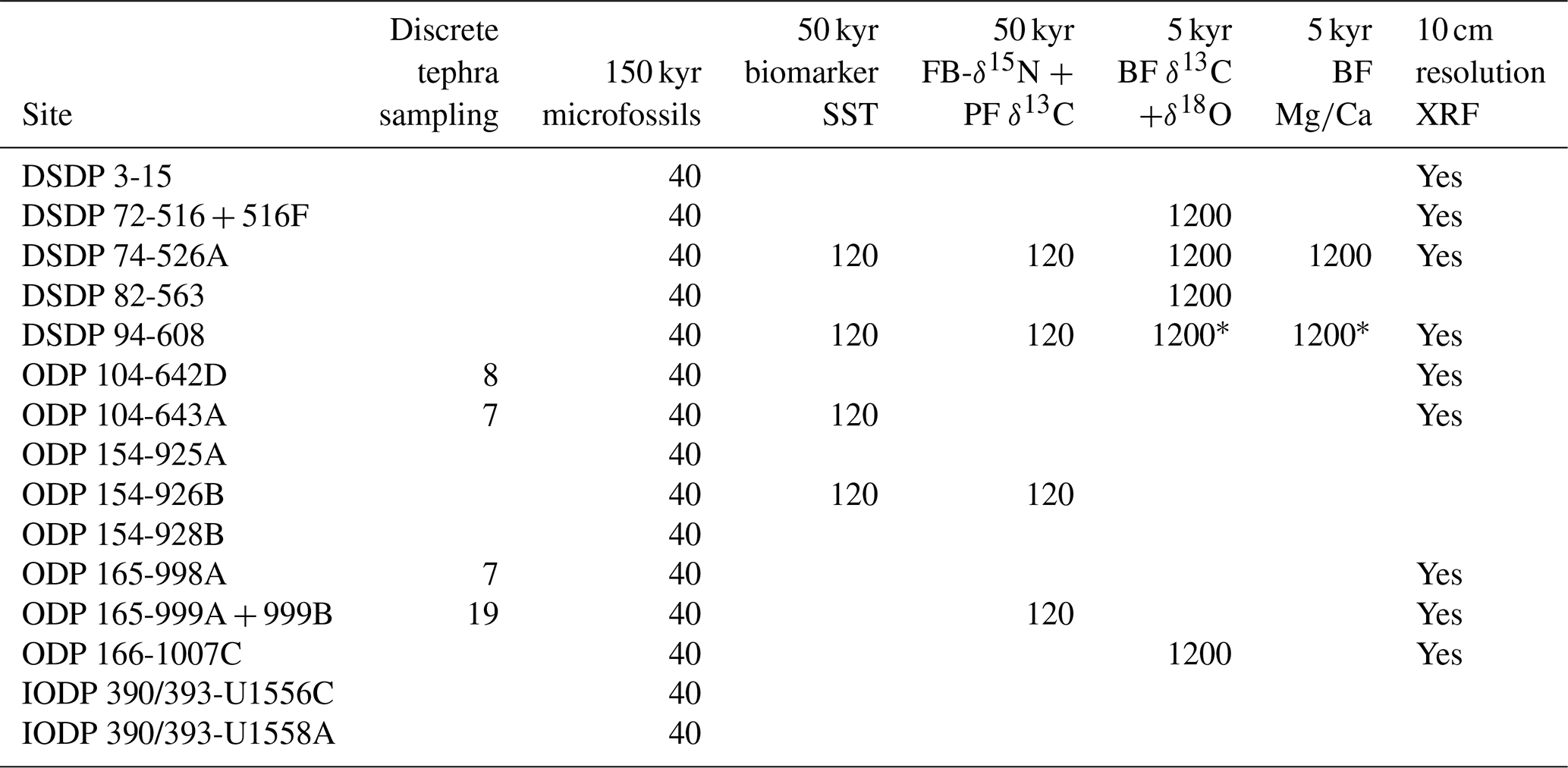
∗ Asterisks indicate intervals that may be too depleted for the sampling proposed.
The success of ENIGMA will be measured via a series of project milestones and regular meetings of the SPARC Expedition Science Team. We anticipate that members of the Science Team will take part in regular meetings once or twice a month to discuss project development, relevant papers, and proposal status. Immediately following the assembly of the Science Team, the co-proponents will act as mentors to PhD students and ECRs to coordinate and co-design complementary sampling projects that help to address the Scientific Objectives. The co-proponent team has significant experience and success in the acquisition of research funding to study scientific ocean-drilling material, and they will work closely with SPARC Expedition Science Team members to acquire supplemental research funding for independent research projects. We will create an email list serv and a cloud-based project file architecture to facilitate efficient communication and collaboration among team members and institutions, including mechanisms for documenting decisions and enabling version control on shared documents. We plan to host hybrid full-team meetings adjacent to professional conferences through and beyond the SPARC timeline to take advantage of the opportunity for many team members to meet in person to review collective progress, assess milestones, and develop potential future research programmes.
4.3 Analytical techniques and methodologies
We will attain our Scientific Objectives through the application of the methodologies described below. However, we also welcome applications from researchers proposing complementary research projects that go beyond the stated research objectives or wishing to apply additional or novel techniques not listed here that may contribute to implementation of the overall ENIGMA Science Plan.
4.3.1 SO1 – Refine chrono-stratigraphic age models of all studied records to assess synchroneity of oceanographic and biotic changes during the early Miocene
Bio-stratigraphy. Bio-stratigraphy is the first-order means for age model creation, and, in this study, we will use multiple fossil groups (planktonic and/or benthic foraminifera, calcareous nannofossils, radiolaria, diatoms, ostracods, bolboformids, silicofossils, palynomorphs). Bio-stratigraphic zonations and datum events will be used to more precisely infer chrons, subchrons, and stable isotope records.
Magneto-stratigraphy. For sites that lack magneto-stratigraphy and/or have identified chron and subchron boundaries with large depth and age errors, we will measure inclination and declination to identify key reversal boundaries. Identification of reversal boundaries will rely heavily on bio-stratigraphy, according to the groups available (see the Supplement).
Benthic foraminiferal δ18O. Stable oxygen isotope time series from benthic foraminifera will be created at a resolution to infer long and short eccentricity cycles for tuning to the benthic foraminiferal stable isotopic stack of Westerhold et al. (2020).
Radioisotopic geochronology. Following the novel application of high-precision U–Pb zircon geochronology to develop a radiometric age model for ODP Site 1000 by Kasbohm et al. (2024), we aim to produce a similar calibration for Sites 998 and 999, which contain ashes highly likely to include zircon, as well as ODP Leg 104 Sites 642 and 643, which contain ashes that may include zircon. Any other ashes or cryptic tephra we encounter via XRF or by core sampling and/or observation will be collected for high-precision U–Pb zircon geochronology, performed in the lab of co-chief Kasbohm.
Orbital tuning and geologic timescale. Orbital tuning will be conducted across the early Miocene for all our target sites. We will use XRF ratios (see below; Table 1) for regional tuning, as well as benthic foraminiferal δ18O data to astronomically tune the study sites to the global oxygen isotope composite of Westerhold et al. (2020). For all efforts described in this proposal, we will use GTS 2020 (Raffi et al., 2020) for numerical age calibration of stratigraphic stages, bio- and magneto-stratigraphy, and astrochronozones.
4.3.2 SO2 – Generate and synthesize records of early Miocene environmental change in the Atlantic Ocean
For biomarker analyses (n-alkanes, alkenones, glycerol dialkyl glycerol tetraether lipids (GDGTs)), all necessary instrumentation is available at the University of Southampton (UK), and co-proponent Auderset will either conduct the measurements or train the assigned researcher. Our investigations of redox indicators (e.g. XRF-derived , , and ) and water mass changes (benthic δ13C and δ18O analyses) can all be performed using analytical equipment at Cardiff University (UK) under the supervision of co-chief Woodhouse.
Temperature and CO2. We will analyse lipid biomarkers in a targeted set of samples, including alkenones (UK37') and GDGTs (e.g. TEX86) for sea surface temperature reconstructions. The proposed lipid biomarkers can be extracted from the same sediment sample followed by separation via column chromatography. We seek to recruit a member of the Expedition Science Team with expertise in benthic foraminiferal trace element ratios () and planktonic foraminiferal boron isotopes, which serve as proxies for deep-ocean temperature and surface ocean pH and/or atmospheric CO2, respectively.
Productivity. We will generate alkenone accumulation rate data to assess primary productivity alongside planktonic–benthic foraminiferal δ13C isotope gradients and XRF ratios (Ba, Cd; Table 1). This multi-proxy approach will provide insights into local to basin-wide productivity changes that may have occurred through the early Miocene.
Terrigenous input. We will investigate the role of terrestrial input at the sites using XRF data to document changes in the relative amounts of terrigenous vs. marine elements (Table 1). We will scan sediment cores using the XRF core scanners present at the Bremen Core Repository (BCR) and Gulf Coast Repository (GCR), using 10, 30, and 50 kV excitation levels at a 10 cm resolution (1095.33 m total; ∼ 304.9 h scanning time) to capture environmental variability at local to basinal scales. A low-resolution approach is sufficient for these analyses as the goal is to capture the compounded and potentially asynchronous nature of environmental perturbations that may have led to the ecological event at ∼ 19 Ma. In addition, in a subset of samples we will measure n-alkanes – land-plant-derived components – to help constrain terrigenous input into sites via wind or rivers.
Ocean oxygenation. We will measure foraminifera-bound nitrogen isotopes (FB-δ15N) in a subset of samples to investigate ocean oxygenation and nitrogen cycle processes like N2 fixation, denitrification, or nutrient consumption. Co-proponent Auderset will perform this work at the University of Southampton, UK, and in collaboration with the Max Planck Institute for Chemistry, Germany. To assess bottom water oxygenation, we will use redox-sensitive XRF ratios (Table 1).
Water mass changes and Antarctic ice sheet volume: We will infer bottom water mass changes with benthic foraminiferal stable isotopes (δ18O and δ13C). Further, paired analyses of benthic foraminiferal δ18O and will help identify the role of AIS growth and decay on bottom water production and circulation changes in the Atlantic Ocean.
4.3.3 SO3 – Collate and create records of early Miocene biotic change
With refined chrono-stratigraphic and environmental data, we will collect fossil assemblage data from all present microfossil groups throughout the Atlantic Ocean target sections (one sample for each core section, 1021 repetitions; see Sect. 4.2) and create an open-access early Miocene fossil occurrence dataset, which will be supplemented by the Triton (Fenton and Woodhouse et al., 2021) and BioDeepTime (Smith et al., 2023) databases. Furthermore, we will perform an extensive literature review to collate and assess all assemblage and geochemical data from expedition reports and post-cruise research, focusing on the techniques described in SO1 and SO2. The SPARC co-proponents are experts in the collection of scientific ocean-drilling micropaleontological data and in updating these to current chrono-stratigraphic frameworks and taxonomic concepts. The ENIGMA Science Team will assess each of these legacy records and will request sample splits from available archived material if they need to reanalyse assemblages to be consistent with their methodology. We will select Science Team members to expand the microfossil expertise to include other groups such as calcareous nannoplankton, ostracods, diatoms, and benthic foraminifera.
4.3.4 SO4 – Assess the collective response of organisms to associated environmental changes using statistical and mechanistic models
With the collective environmental and ecosystem data, we will implement the Micropaleoecology Framework (Woodhouse et al., 2024) to determine how the holistic marine ecosystem of the Atlantic Ocean responded to the early Miocene paleoenvironment. To investigate relationships and causality between and among biotic and environmental factors, we plan to develop and adapt cutting-edge techniques in causal inference, complex systems, and statistical learning (prior work from the team includes Antell et al., 2024; Fagan et al., 2022; Smith et al., 2023; Staples et al., 2025; Swain and Woodhouse et al., 2024; Woodhouse et al., 2023b). These tools range from network-based tools and statistical learning methods (Swain and Woodhouse et al., 2024) to lag-time-explicit causal inference techniques (Fagan et al., 2022) and spatially explicit occurrence models (Antell et al., 2024).
Based on the results from the quantitative analyses of the database, we will build mechanistic models to test our observed patterns from first principles. The nature of these models will vary based on the upstream results in this SO; however, they will coarsely be an environmentally coupled dynamic species interaction model (including trophic relationships and niche-based associations). Our approach will yield the most spatially complete analysis of the fossilizing components of the marine trophic system ever conducted, and it will involve adapting and developing new statistical and mathematical frameworks to quantify the responses of various species and niche groups during this critical interval of biosphere evolution. All methods, data, and user guides will be made available in public repositories and will be made completely open access in accordance with the European Data Act.
4.3.5 SO5 – Develop climate model simulations to investigate ocean evolution during the early Miocene and assess forcing factors
In the absence of a dedicated modelling effort targeting the early Miocene, we plan to develop our own climate model simulation dataset to integrate with the ENIGMA reconstructions. To do so, we plan to generate new Earth system model simulations to evaluate the response of climate–ocean dynamics, as well as nutrient, productivity, and dissolved oxygen, to a variety of forcing mechanisms at play during the early Miocene (e.g. tectonic gateways, pCO2, orbital configuration, cryosphere changes including sea ice and deep-water formation). We plan to leverage an existing early Miocene modelling setup (e.g. Sarr et al., 2022; Valdes et al., 2021) that implemented boundary conditions for ∼ 20 Ma. Using this existing setup will provide a solid base to quickly develop the first modelling dataset targeting the ∼ 19 Ma oceanic and biotic event. Our first focus will be to evaluate the role of early Miocene high-latitude and tropical seaways (see Sect. 1) in modifying the global ocean circulation and setting up environmental patterns. We will refine or reorient the modelling framework (and design appropriate additional simulations) during the ENIGMA project as more data become available. In complement, we also plan to rely on the MIOMIP1 opportunistic ensemble (Burls et al., 2021) to provide preliminary results for how various states of ocean circulation affect the ocean; indeed, though it focuses on MCO simulation, this ensemble shows a wide variety of global circulation patterns and thus can provide useful information (Naik et al., 2025).
The analysis of already available simulations will help us immediately orient the development of our new records as it may point toward sites or data types that would provide key information. Once benchmarked against the detailed Atlantic records from ENIGMA, simulations will help us refine our mechanistic understanding of early Miocene global ocean and biotic evolution; they will also be used to design future targets, including in other oceanic basins, in work following ENIGMA. In addition, the modelling framework derived here might push for the development of a more extended paleo-modelling effort including other types of climate models.
Throughout the lifespan of ENIGMA and beyond, we plan to incorporate Earth system models alongside geodynamic models to simulate the complex interactions between the atmosphere, ocean, land surface, and cryosphere under early Miocene boundary conditions. Specifically, models will be applied to reconstruct paleoclimate using early Miocene continental positions, terrestrial and marine topography, vegetation patterns, estimated CO2 concentrations, global temperature distributions, precipitation patterns, atmospheric and ocean circulation, and ice sheet dynamics (Fig. 5; Ramsay et al., 1998; von der Heydt and Dijkstra, 2006; Liebrand et al., 2016, 2017; Field et al., 2018; Naik et al., 2025). Earth system and geodynamic models can be applied synchronously to focus on underlying geological processes that influence long-term climate and will allow for a direct comparison with the proxy data generated from ENIGMA, informing future proxy and/or sample targets.
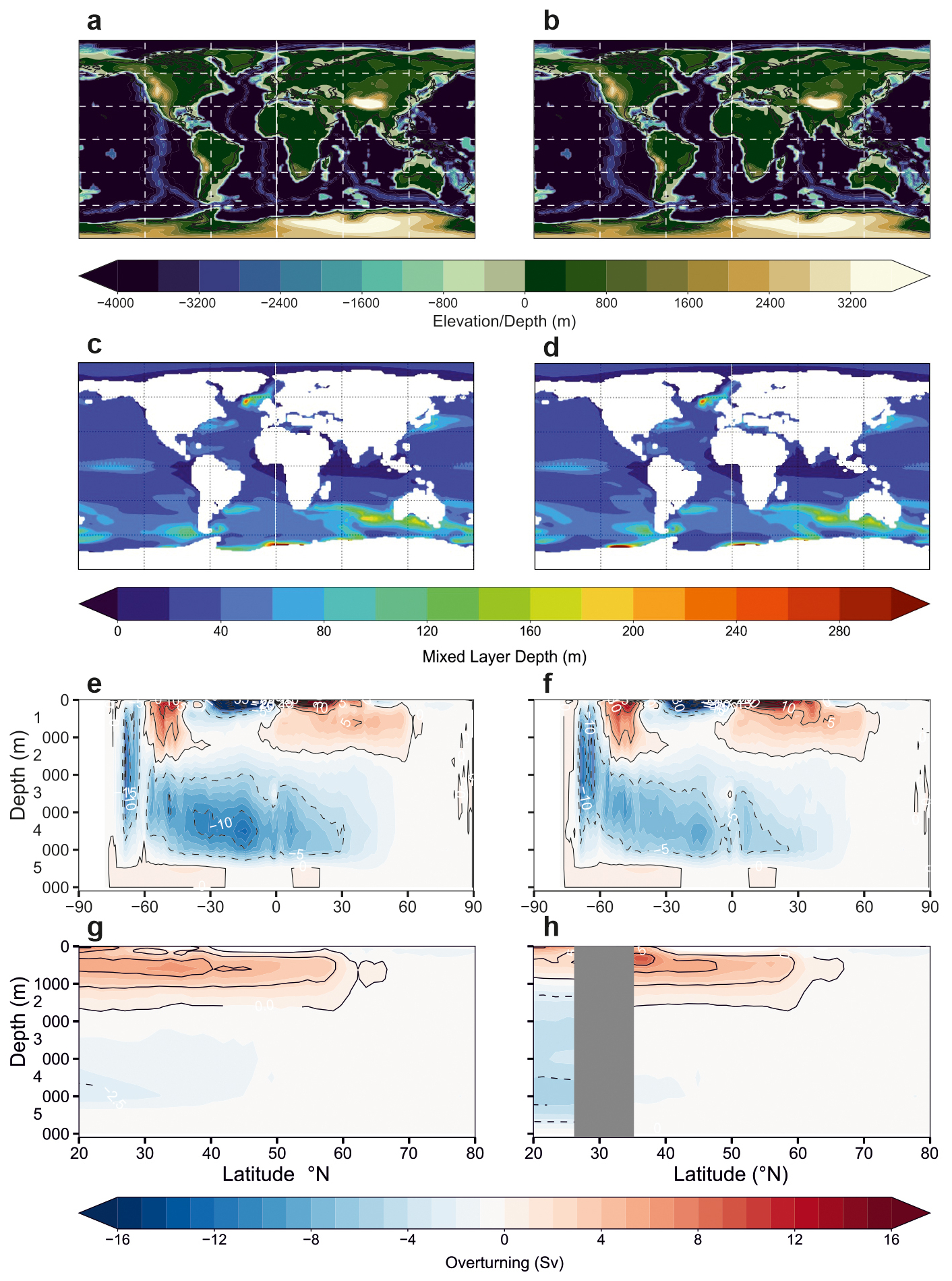
Figure 5Modelled paleogeography and paleoceanography at ∼ 20 Ma. (a, b) Paleogeography and paleobathymetry; (c, d) annual average mixed-layer depth; (e, f) global meridional overturning circulation; (g, h) meridional overturning circulation in the North Atlantic. (a, c, e, g) IPSLCM5 scenario, Tethys closed; (b, d, f, h) IPSLCM5_T scenario, Tethys open. Modified from Naik et al. (2025).
With regard to risk mitigation, ENIGMA will incorporate a number of mitigation strategies to improve the likelihood of the project's success. Key components that require contingencies include the following:
-
Fossil preservation potential. To mitigate the possibility of preservation changes being interpreted as assemblage and/or community dynamics, ENIGMA will combine cruise and post-cruise research observations and XRF elemental data with detailed records of the preservation of each microfossil study group to monitor any significant fluctuations in preservation that may lead to interpretation biases. Further, prior to geochemical analyses, external and internal specimen preservation will be assessed through scanning electron microscopy.
-
Incompatible age models. The synchronization of data from different regions during the Miocene is only possible when deep-sea sites are placed on the same timescale with updated age models (Westerhold et al., 2024). Due to the spatial distance and environmental heterogeneity of the study sites, there is a possibility that we may be unable to directly compare biotic responses on a synchronized timescale. However, through the generation of XRF, bio-stratigraphic, stable isotopic, geochronologic, cyclo-stratigraphic, and magneto-stratigraphic data, the likelihood of such an occurrence is significantly reduced.
-
XRF scanning incomplete. ENIGMA aims to conduct ∼ 305 h of total XRF scanning (10 cm resolution, three excitation levels), requiring ∼ 5 d at the GCR for Leg 165 Sites and constant scanning for the duration of the scientific party meeting at the BCR for the remainder (∼ 2 weeks). Here, there may be potential time losses due to core preparation for the scanning process and/or rescanning of critical sampling intervals. To address this possibility, ENIGMA includes multiple sites from the same drilling expedition. Therefore, if time constraints warrant the need for fewer XRF scans, select cores will be deprioritized.
-
Proxy challenges. We will mitigate the possibility of low biomarker concentrations in some intervals by increasing the sample size and concentrating the extract prior to HPLC-MS analysis for GDGTs. For FB-δ15N and δ11B, the primary limitation is the availability of sufficient planktonic foraminifera, as each analysis requires ∼ 400 individuals. Where necessary we will adopt a genus-level rather than species-specific approach and consider combining adjacent samples or increasing sample volume to ensure sufficient material for isotopic analysis. Co-proponents collectively have the expertise to justify coarser selection based on their complementary taxonomic and palaeoecological skillsets.
Staffing of the SPARC Expedition Science Team involves a competitive process following an open call for participation published on the IODP3 website (https://iodp3.org, last access: 7 March 2026). Applications are evaluated by the scientific ocean-drilling Programme Member Offices, with staffing nominations taking into account both the scientific background of applicants; the scientific needs of the SPARC; and programmatic national, gender, and career stage balances.
All research data are available from the source publications and from IODP websites.
The supplement related to this article is available online at https://doi.org/10.5194/piodp-505S-1-2026-supplement.
AW and JK wrote and edited the Scientific Prospectus. AW developed the sampling plan.
The contact author has declared that none of the authors has any competing interests.
Publisher's note: Copernicus Publications remains neutral with regard to jurisdictional claims made in the text, published maps, institutional affiliations, or any other geographical representation in this paper. The authors bear the ultimate responsibility for providing appropriate place names. Views expressed in the text are those of the authors and do not necessarily reflect the views of the publisher.
This SPARC Expedition will use legacy samples and data provided by the Deep Sea Drilling Project, Ocean Drilling Program, and the International Ocean Discovery Program. ENIGMA was conceived of and proposed by the members of the Early Miocene Working Group: Gawain Antell, Alexandra Auderset, Imogen Browne, Jesse Farmer, Anya Hess, Jennifer Kasbohm, Adriane Lam, Kenji Matsuzaki, Elizabeth Sibert, Jansen Smith, Anshuman Swain, and Adam Woodhouse. All of the members of the working group contributed to this prospectus. We thank Anta-Clarisse Sarr for her help with the development of a modelling component for ENIGMA and drafting of the plan included in the prospectus. We thank Mike Weber and Gerald Dickens for their reviews of this prospectus.
This paper was edited by Simon Jung and reviewed by Michael E. Weber, Gerald R. Dickens, and Timothy Reston.
Abreu, V. S. and Haddad, G. A.: Glacioeustatic Fluctuations: The Mechanism Linking Stable Isotope Events and Sequence Stratigraphy from the Early Oligocene to Middle Miocene, in: Mesozoic and Cenozoic Sequence Stratigraphy of European Basins, SEPM Society for Sedimentary Geology, https://doi.org/10.2110/pec.98.02.0245, 1999.
Albasrawi, W. A.: Early Miocene quantitative calcareous nannofossil biostratigraphy from the tropical Atlantic, University of Nebraska-Lincoln, https://digitalcommons.unl.edu/geosciencefacpub/721/ (last access: 27 November 2025), 2016.
Antell, G. T., Benson, R. B. J., and Saupe, E. E.: Spatial standardization of taxon occurrence data-a call to action, Paleobiology, 50, 177–193, https://doi.org/10.1017/pab.2023.36, 2024.
Auderset, A., Moretti, S., Taphorn, B., Ebner, P. R., Kast, E., Wang, X. T., Schiebel, R., Sigman, D. M., Haug, G. H., and Martínez-García, A.: Enhanced ocean oxygenation during Cenozoic warm periods, Nature, 609, 77-+, https://doi.org/10.1038/s41586-022-05017-0, 2022.
Bach, L. T., Taucher, J., Boxhammer, T., Ludwig, A., Achterberg, E. P., Algueró-Muñiz, M., Anderson, L. G., Bellworthy, J., Büdenbender, J., Czerny, J., Ericson, Y., Esposito, M., Fischer, M., Haunost, M., Hellemann, D., Horn, H. G., Hornick, T., Meyer, J., Sswat, M., Zark, M., Riebesell, U., and Consortium, K. K.: Influence of Ocean Acidification on a Natural Winter-to-Summer Plankton Succession: First Insights from a Long-Term Mesocosm Study Draw Attention to Periods of Low Nutrient Concentrations, PLoS One, 11, e0159068, https://doi.org/10.1371/journal.pone.0159068, 2016.
Baldauf, J. G., Thomas, E., Clement, B., Takayama, T., Weaver, P. P. E., Backman, J., Jenkins, G., Mudie, P. J., and Westbergsmith, M. J.: Magnetostratigraphic and Biostratigraphic Synthesis, Deep-Sea Drilling Project Leg-94, Initial Reports of the Deep Sea Drilling Project, 94, 1159–1205, 1987.
Barron, J. A. and Keller, G.: Widespread Miocene Deep-Sea Hiatuses - Coincidence with Periods of Global Cooling, Geology, 10, 577–581, https://doi.org/10.1130/0091-7613(1982)10<577:Wmdhcw>2.0.Co;2, 1982.
Bauer, J. E., Lam, A. R., and Lundgren, L.: Facebook promotions keep people in the social media ecosystem, but do not encourage outside engagement, Zenodo, https://doi.org/10.5281/zenodo.7605674, 2023.
Baum, J. K., Claar, D. C., Tietjen, K. L., Magel, J. M. T., Maucieri, D. G., Cobb, K. M., and McDevitt-Irwin, J. M.: Transformation of coral communities subjected to an unprecedented heatwave is modulated by local disturbance, Sci. Adv., 9, eabq5615, https://doi.org/10.1126/sciadv.abq5615, 2023.
Benson, R. H. and Peypouquet, J. P.: The Upper and Mid-Bathyal Cenozoic Ostracode Faunas of the Rio-Grande Rise Found on Leg-72 Deep-Sea Drilling Project, Initial Reports of the Deep Sea Drilling Project, 72, 805–818, 1983.
Bergen, J. A., de Kaenel, E., Blair, S. A., Boesiger, T. M., and Browning, E.: Oligocene-Pliocene taxonomy and stratigraphy of the genus Sphenolithus in the circum North Atlantic Basin: Gulf of Mexico and ODP Leg 154, J. Nannoplankton Res., 37, 77–112, 2017.
Berggren, W. A., Hamilton, N., Johnson, D. A., Pujol, C., Weiss, W., Cepek, P., and Gombos, A. M.: Magnetobiostratigraphy of Deep-Sea Drilling Project Leg-72, Sites 515-518, Rio-Grande Rise (South-Atlantic), Initial Reports of the Deep Sea Drilling Project, 72, 939–947, 1983a.
Berggren, W. A., Aubry, M. P., and Hamilton, N.: Neogene Magnetobiostratigraphy of Deep-Sea Drilling Project Site-516 (Rio-Grande Rise, South-Atlantic), Initial Reports of the Deep Sea Drilling Project, 72, 675–713, 1983b.
Billups, K., Rickaby, R. E. M., and Schrag, D. P.: Cenozoic pelagic Sr/Ca records: Exploring a link to paleoproductivity, Paleoceanography, 19, PA3005,https://doi.org/10.1029/2004pa001011, 2004.
Bitschene, P. R., Schmincke, H.-U., and Viereck, L.: Cenozoic Ash Layers on the Vøring Plateau (ODP Leg 104), in: Proceedings of the Ocean Drilling Program, 104 Scientific Results, Ocean Drilling Program, https://doi.org/10.2973/odp.proc.sr.104.129.1989, 1989.
Bleil, U.: Magnetostratigraphy of Neogene and Quaternary Sediment Series from the Norwegian Sea: Ocean Drilling Program, Leg 104, in: Proceedings of the Ocean Drilling Program, 104 Scientific Results, Ocean Drilling Program, https://doi.org/10.2973/odp.proc.sr.104.181.1989, 1989.
Blow, W. H.: Deep Sea Drilling Project, Leg 3 Foraminifera from Selected Samples, in: Initial Reports of the Deep Sea Drilling Project, 3, U.S. Government Printing Office, https://doi.org/10.2973/dsdp.proc.3.120.1970, 1970.
Boersma, A.: Cretaceous-Tertiary Planktonic Foraminifers from the Southeastern Atlantic, Walvis Ridge Area, Deep-Sea Drilling Project Leg 74, Initial Reports of the Deep Sea Drilling Project, 74, 501–523, 1984a.
Boersma, A.: Oligocene and Other Tertiary Benthic Foraminifers from a Depth Traverse down Walvis Ridge, Deep-Sea Drilling Project Leg 74, Southeast Atlantic, Initial Reports of the Deep Sea Drilling Project, 75, 1273–1300, 1984b.
Boesiger, T. M., De Kaenel, E., Bergen, J. A., Browning, E., and Blair, S. A.: Oligocene to Pleistocene taxonomy and stratigraphy of the genus Helicosphaera and other placolith taxa in the circum North Atlantic Basin, J. Nannoplankton Res., 37, 145–175, 2017.
Boscolo-Galazzo, F., Crichton, K. A., Ridgwell, A., Mawbey, E. M., Wade, B. S., and Pearson, P. N.: Temperature controls carbon cycling and biological evolution in the ocean twilight zone, Science, 371, 1148-+, https://doi.org/10.1126/science.abb6643, 2021.
Brownstein, C. D., Harrington, R. C., Alencar, L. R. V, Bellwood, D. R., Choat, J. H., Rocha, L. A., Wainwright, P. C., Tavera, J., Burress, E. D., Muñoz, M. M., Cowman, P. F., and Near, T. J.: Phylogenomics establishes an Early Miocene reconstruction of reef vertebrate diversity, Sci. Adv., 11, eadu6149, https://doi.org/10.1126/sciadv.adu6149, 2025.
Bukry, D.: Mid-Atlantic Ridge Coccolith and Silicoflagellate Biostratigraphy, Deep-Sea Drilling Project Site-558 and Site-563, Initial Reports of the Deep Sea Drilling Project, 82, 591–603, 1985.
Bukry, D. and Bramlette, M. N.: Coccolith Age Determinations Leg 3, Deep Sea Drilling Project, in: Initial Reports of the Deep Sea Drilling Project, 3, U.S. Government Printing Office, https://doi.org/10.2973/dsdp.proc.3.118.1970, 1970.
Burls, N. J., Bradshaw, C. D., De Boer, A. M., Herold, N., Huber, M., Pound, M., Donnadieu, Y., Farnsworth, A., Frigola, A., Gasson, E., von der Heydt, A. S., Hutchinson, D. K., Knorr, G., Lawrence, K. T., Lear, C. H., Li, X., Lohmann, G., Lunt, D. J., Marzocchi, A., Prange, M., Riihimaki, C. A., Sarr, A. -C., Siler, N., and Zhang, Z.: Simulating Miocene Warmth: Insights From an Opportunistic Multi-Model Ensemble (MioMIP1), Paleoceanogr. Paleoclimatol., 36, https://doi.org/10.1029/2020PA004054, 2021.
Carey, S. and Sigurdsson, H.: Grain Size of Miocene Volcanic Ash Layers From Sites 998, 999, and 1000: Implications for Source Areas and Dispersal, Proc. ODP, Sci. Result., 165, 101–113, 2000.
De Carlo, E. H. and Kramer, P. A.: Minor and trace elements in interstitial waters of the Great Bahama Bank: results from ODP Leg 166, in: Proceedings of the Ocean Drilling Program, 166 Scientific Results, Ocean Drilling Program, https://doi.org/10.2973/odp.proc.sr.166.118.2000, 2000.
Chaisson, W. P. and D'Hondt, S. L.: 2. NEOGENE PLANKTONIC FORAMINIFER BIOSTRATIGRAPHY AT SITE 999, WESTERN CARIBBEAN SEA 1, Scientific Results, https://doi.org/10.2973/odp.proc.sr.165.010.2000, 2000.
Ciesielski, P. F., Hasson, P., and Turner Jr., J. W.: The Stratigraphy of Neogene Silicoflagellates from the Norwegian Sea, ODP Leg 104, in: Proceedings of the Ocean Drilling Program, 104 Scientific Results, Ocean Drilling Program, https://doi.org/10.2973/odp.proc.sr.104.164.1989, 1989.
Clark, W. and Totten, R. L.: Nutrient Shift in the Yucatan Basin during the late Early Miocene: Evidence from calcareous nannofossils and stable isotopes at ODP Leg 165 Site 998 Hole A, Palaeogeogr. Palaeoclimatol. Palaeoecol., 655, 112474, https://doi.org/10.1016/j.palaeo.2024.112474, 2024.
Coggon, R. M., Sylvan, J. B., Estes, E. R., Teagle, D. A. H., Reece, J., Williams, T. J., Christeson, G. L., Aizawa, M., Borrelli, C., Bridges, J. D., Carter, E. J., Dinarès-Turell, J., Estep, J. D., Gilhooly III, W. P., Grant, L. J. C., Kaplan, M. R., Kempton, P. D., Lowery, C. M., McIntyre, A., Routledge, C. M., Slagle, A. L., Takada, M., Tamborrino, L., Wang, Y., Yang, K., Albers, E., Amadori, C., Belgrano, T. M., D'Angelo, T., Doi, N., Evans, A., Guérin, G. M., Harris, M., Hojnacki, V. M., Hong, G., Jin, X., Jonnalagadda, M., Kuwano, D., Labonte, J. M., Lam, A. R., Latas, M., Lu, W., Moal-Darrigade, P., Pekar, S. F., Robustelli Test, C., Ryan, J. G., Santiago Ramos, D., Shchepetkina, A., Villa, A., Wee, S. Y., Widlansky, S. J., Kurz, W., Prakasam, M., Tian, L., Yu, T., and Zhang, G.: Site U1556, Proceedings of the International Ocean Discovery Program Volume 390/393, https://doi.org/10.14379/iodp.proc.390393.103.2024, 2024.
Coles, G. and Whatley, R. C.: New Palaeocene to Miocene genera and species of ostracoda from DSDP sites in the North Atlantic, Revista española de micropaleontología, 21, 81–124, 1989.
Cramer, B. S., Toggweiler, J. R., Wright, J. D., Katz, M. E., and Miller, K. G.: Ocean overturning since the Late Cretaceous: Inferences from a new benthic foraminiferal isotope compilation, Paleoceanography, 24, Pa4216, https://doi.org/10.1029/2008pa001683, 2009.
Curry, W. B., Shackleton, N. J., and Richter, C. (Eds.): Proceedings of the Ocean Drilling Program, 154 Initial Reports, Ocean Drilling Program, https://doi.org/10.2973/odp.proc.ir.154.1995, 1995.
De Kaenel, E., Bergen, J., Browning, E., Blair, S., and Boesiger, T.: Uppermost Oligocene to middle Miocene discoaster and catinaster taxonomy and stratigraphy in the circum north atlantic basin: Gulf of Mexico and ODP leg 154, J. Nannoplankt. Res., 37, 215–244, 2017.
Dellinger, M., Hardisty, D. S., Planaysky, N. J., Gill, B. C., Kalderon-Asael, B., Asael, D., Croissant, T., Swart, P. K., and West, A. J.: The Effects of Diagenesis on Lithium Isotope Ratios of Shallow Marine Carbonates, Am. J. Sci., 320, 150–184, https://doi.org/10.2475/02.2020.03, 2020.
Dequadros, L. P., Soldan, A. L., and Demelo, U.: Geochemical Analyses of Samples from Hole-515b, Vema Channel, and Hole-516f, Rio-Grande Rise, Initial Reports of the Deep Sea Drilling Project, 72, 841–845, 1983.
Despraires, A., Tremblay, P., and Laloy, C.: Secondary Mineral Assemblages in a Volcanic Sequence Drilled during ODP Leg 104 in the Norwegian Sea, in: Proceedings of the Ocean Drilling Program, 104 Scientific Results, Ocean Drilling Program, https://doi.org/10.2973/odp.proc.sr.104.142.1989, 1989.
Diester-Haass, L., Billups, K., Gröcke, D. R., François, L., Lefebvre, V., and Emeis, K. C.: Mid-Miocene paleoproductivity in the Atlantic Ocean and implications for the global carbon cycle, Paleoceanography, 24, Pa1209, https://doi.org/10.1029/2008pa001605, 2009.
Diester-Haass, L., Billups, K., and Emeis, K.: Enhanced paleoproductivity across the Oligocene/Miocene boundary as evidenced by benthic foraminiferal accumulation rates, Palaeogeogr. Palaeoclimatol. Palaeoecol., 302, 464–473, https://doi.org/10.1016/j.palaeo.2011.02.006, 2011.
Dillon, E. M. and Pimiento, C.: Aligning paleobiological research with conservation priorities using elasmobranchs as a model, Paleobiology, 51, 112–131, https://doi.org/10.1017/pab.2024.11, 2025.
Di Martino, E., Jackson, J. B. C., Taylor, P. D., and Johnson, K. G.: Differences in extinction rates drove modern biogeographic patterns of tropical marine biodiversity, Sci. Adv., 4, eaaq1508, https://doi.org/10.1126/sciadv.aaq1508, 2018.
Dobson, D. M., Dickens, G. R., and Rea, D. K.: Terrigenous sediment on Ceara Rise: a Cenozoic record of South American orogeny and erosion, Palaeogeogr. Palaeoclimatol. Palaeoecol., 165, 215–229, https://doi.org/10.1016/S0031-0182(00)00161-9, 2001.
Dominici, S., Danise, S., Cau, S., and Freschi, A.: The awkward record of fossil whales, Earth Sci. Rev., 205, 103057, https://doi.org/10.1016/j.earscirev.2019.103057, 2020.
Doney, S. C., Busch, D. S., Cooley, S. R., and Kroeker, K. J.: The Impacts of Ocean Acidification on Marine Ecosystems and Reliant Human Communities, Ann. Rev. Environ. Resour., 45, 83–112, https://doi.org/10.1146/annurev-environ-012320-083019, 2020.
Dulvy, N. K., Pacoureau, N., Rigby, C. L., Pollom, R. A., Jabado, R. W., Ebert, D. A., Finucci, B., Pollock, C. M., Cheok, J., Derrick, D. H., Herman, K. B., Sherman, C. S., VanderWright, W. J., Lawson, J. M., Walls, R. H. L., Carlson, J. K., Charvet, P., Bineesh, K. K., Fernando, D., Ralph, G. M., Matsushiba, J. H., Hilton-Taylor, C., Fordham, S., and Simpfendorfer, C. A.: Overfishing drives over one-third of all sharks and rays toward a global extinction crisis, Curr. Biol., 31, 4773-+, https://doi.org/10.1016/j.cub.2021.08.062, 2021.
Dutkiewicz, A. and Müller, R. D.: Deep-sea hiatuses track the vigor of Cenozoic ocean bottom currents, Geology, 50, 710–715, https://doi.org/10.1130/G49810.1, 2022.
Eberli, G. P., Swart, P. K., and Malone, M. J. (Eds.): Proceedings of the Ocean Drilling Program, 166 Initial Reports, Ocean Drilling Program, https://doi.org/10.2973/odp.proc.ir.166.1997, 1997.
Echols, D. J.: Lower Oligocene through Pleistocene Planktonic Foraminiferal Biostratigraphy, North-Atlantic Site-558 and Site-563 (Mid-Atlantic Ridge), Initial Reports of the Deep Sea Drilling Project, 82, 547–558, 1985.
Ehlers, B. M. and Jokat, W.: Paleo-bathymetry of the northern North Atlantic and consequences for the opening of the Fram Strait, Mar. Geophys. Rese., 34, 25–43, https://doi.org/10.1007/s11001-013-9165-9, 2013.
Eldholm, O., Thiede, J., and Taylor, E. (Eds.): Proceedings of the Ocean Drilling Program, 104 Initial Reports, Ocean Drilling Program, https://doi.org/10.2973/odp.proc.ir.104.1987, 1987.
Fagan, W. F., Swain, A., Banerjee, A., Ranade, H., Thompson, P., Staniczenko, P. P. A., Flynn, B., Hungerford, J., and Hurwitz, S.: Quantifying Interdependencies in Geyser Eruptions at the Upper Geyser Basin, Yellowstone National Park, J. Geophys.l Res.-Solid Earth, 127, e2021JB023749, https://doi.org/10.1029/2021JB023749, 2022.
Evans, H. F.: Relationships between core recovery, coring systems, and sedimentary lithology for scientific ocean drilling, JRSO Technical Report No. 1. International Ocean Discovery Program, https://iodp.tamu.edu/publications/JRSO/TR_1/TechReport_TR_1.pdf (last access: 7 March 2026), 2020.
Fenton, I. S., Woodhouse, A., Aze, T., Lazarus, D., Renaudie, J., Dunhill, A. M., Young, J. R., and Saupe, E. E.: Triton, a new species-level database of Cenozoic planktonic foraminiferal occurrences, Sci. Data, 8, 160, https://doi.org/10.1038/s41597-021-00942-7, 2021.
Field, B. D., Browne, G. H., Fielding, C. R., Florindo, F., Harwood, D. M., Judge, S. A., Krissek, L. A., Panter, K. S., Passchier, S., Pekar, S. F., Sandroni, S., and Talarico, F. M.: A sedimentological record of early Miocene ice advance and retreat, AND-2A drill hole, McMurdo Sound, Antarctica, Geosphere, 14, 1780–1803, https://doi.org/10.1130/GES01592.1, 2018.
Florindo, F., Gennari, R., Persico, D., Turco, E., Villa, G., Lurcock, P. C., Roberts, A. P., Winkler, A., Carter, L., and Pekar, S. F.: New magnetobiostratigraphic chronology and paleoceanographic changes across the Oligocene-Miocene boundary at DSDP Site 516 (Rio Grande Rise, SW Atlantic), Paleoceanography, 30, 659–681, https://doi.org/10.1002/2014pa002734, 2015.
Flower, B. P., Zachos, J. C., and Martin, E.: Latest Oligocene through early Miocene isotopic stratigraphy and deep-water paleoceanography of the western equatorial Atlantic: Sites 926 and 929, in: Proceedings of the Ocean Drilling Program, 154 Scientific Results, Ocean Drilling Program, https://doi.org/10.2973/odp.proc.sr.154.142.1997, 1997.
Fraass, A. J., Leckie, R. M., Lowery, C. M., and DeConto, R.: Precision in Biostratigraphy: Evidence for a Temporary Flow Reversal in the Central American Seaway during or after the Oligocene-Miocene Transition, J. Foraminifer Res., 49, 357–366, https://doi.org/10.2113/gsjfr.49.4.357, 2019.
Frank, T. D.: Data Report: Geochemistry of Miocene sediments, Sites 1006 and 1007, Leeward Margin, Great Bahama Bank, in: Proceedings of the Ocean Drilling Program, 166 Scientific Results, Ocean Drilling Program, https://doi.org/10.2973/odp.proc.sr.166.124.2000, 2000.
Froget, C., Desprairies, A., Latouche, C., and Maillet, N.: Paleoenvironmental Significance of Cenozoic Clay Deposits from the Norwegian Sea: ODP Leg 104, in: Proceedings of the Ocean Drilling Program, 104 Scientific Results, Ocean Drilling Program, https://doi.org/10.2973/odp.proc.sr.104.112.1989, 1989.
Futterer, D. K.: Pithonelloid Calcareous Dinoflagellates from the Upper Cretaceous and Cenozoic of the Southeastern Atlantic-Ocean, Deep-Sea Drilling Project Leg-74, Initial Reports of the Deep Sea Drilling Project, 74, 533–541, 1984.
Gartner, S.: Miocene Nannofossil Chronology in the North-Atlantic, Dsdp Site-608, Mar. Micropaleontol., 18, 307–331, https://doi.org/10.1016/0377-8398(92)90045-L, 1992.
Gennari, R., Persico, D., Turco, E., Villa, G., Iaccarino, S. M., Florindo, F., Lurcock, P. C., and Zerfass, G. D. D.: High-resolution integrated calcareous plankton biostratigraphy and magnetostratigraphy at the Oligocene-Miocene transition in Southwestern Atlantic Ocean, Geol. J., 53, 1079–1101, https://doi.org/10.1002/gj.2945, 2018.
Goll, R. M.: A Synthesis of Norwegian Sea Biostratigraphies: ODP Leg 104 on the Vøring Plateau, in: Proceedings of the Ocean Drilling Program, 104 Scientific Results, Ocean Drilling Program, https://doi.org/10.2973/odp.proc.sr.104.203.1989, 1989.
Goll, R. M. and Bjørklund, K. R.: A New Radiolarian Biostratigraphy for the Neogene of the Norwegian Sea: ODP Leg 104, in: Proceedings of the Ocean Drilling Program, 104 Scientific Results, Ocean Drilling Program, https://doi.org/10.2973/odp.proc.sr.104.205.1989, 1989.
Gombos, A. M.: Survey of Diatoms in the Upper Oligocene and Lower Miocene in Hole-515b and Hole-516f, Initial Reports of the Deep Sea Drilling Project, 72, 793–804, 1983.
Greenop, R., Sosdian, S. M., Henehan, M. J., Wilson, P. A., Lear, C. H., and Foster, G. L.: Orbital Forcing Ice Volume, and CO2 Across the Oligocene -Miocene Transition, Paleoceanogr. Paleoclimatol., 34, 316–328, https://doi.org/10.1029/2018pa003420, 2019.
Guitián, J., Jones, T. D., Hernández-Almeida, I., Löffel, T., and Stoll, H. M.: Adaptations of Coccolithophore Size to Selective Pressures During the Oligocene to Early Miocene High CO2 World, Paleoceanogr. Paleoclimatol., 35, e2020PA003918, https://doi.org/10.1029/2020PA003918, 2020.
Harper, D. T., Lam, A. R., Penman, D., Frieling, J., Varela, N., and Chatterjee, S.: The value of scientific ocean drilling for early career researchers, Nat. Geosci., 17, 1184, https://doi.org/10.1038/s41561-024-01605-z, 2024.
Harzhauser, M., Kroh, A., Mandic, O., Piller, W. E., Göhlich, U., Reuter, M., and Berning, B.: Biogeographic responses to geodynamics:: A key study all around the Oligo-Miocene Tethyan Seaway, Zool. Anz., 246, 241–256, https://doi.org/10.1016/j.jcz.2007.05.001, 2007.
Hayward, B. W., Johnson, K., Sabaa, A. T., Kawagata, S., and Thomas, E.: Cenozoic record of elongate, cylindrical, deep-sea benthic foraminifera in the North Atlantic and equatorial Pacific Oceans, Mar. Micropaleontol., 74, 75–95, https://doi.org/10.1016/j.marmicro.2010.01.001, 2010.
Hempel, P., Mayer, L., Taylor, E., Bohrmann, G., and Pittenger, A.: The Influence of Biogenic Silica on Seismic Lithostratigraphy at ODP Sites 642 and 643 in the Eastern Norwegian Sea, in: Proceedings of the Ocean Drilling Program, 104 Scientific Results, Ocean Drilling Program, https://doi.org/10.2973/odp.proc.sr.104.200.1989, 1989.
Henrich, R., Wolf, T., Bohrmann, G., and Thiede, J.: Cenozoic Paleoclimatic and Paleoceanographic Changes in the Northern Hemisphere Revealed by Variability of Coarse-Fraction Composition in Sediments from the Vøring Plateau – ODP Leg 104 Drill Sites, in: Proceedings of the Ocean Drilling Program, 104 Scientific Results, Ocean Drilling Program, https://doi.org/10.2973/odp.proc.sr.104.196.1989, 1989.
Henry, K. W. and Opdyke, N. D.: Paleomagnetism of Specimens from Leg 3 of the Deep Sea Drilling Project, in: Initial Reports of the Deep Sea Drilling Project, 3, U.S. Government Printing Office, https://doi.org/10.2973/dsdp.proc.3.122.1970, 1970.
Herbert, T. D., Lawrence, K. T., Tzanova, A., Peterson, L. C., Caballero-Gill, R., and Kelly, C. S.: Late Miocene global cooling and the rise of modern ecosystems, Nat. Geosci., 9, 843-+, https://doi.org/10.1038/Ngeo2813, 2016.
Hess, A. V, Auderset, A., Rosenthal, Y., Miller, K. G., Zhou, X. L., Sigman, D. M., and Martínez-García, A.: A well-oxygenated eastern tropical Pacific during the warm Miocene, Nature, 619, 521-+, https://doi.org/10.1038/s41586-023-06104-6, 2023.
Hess, J., Stott, L. D., Bender, M. L., Kennett, J. P., and Schilling, J. G.: The Oligocene Marine Microfossil Record: Age Assessments Using Strontium Isotopes, Paleoceanography, 4, 655–679, https://doi.org/10.1029/PA004i006p00655, 1989.
Higgins, J. A. and Schrag, D. P.: Constraining magnesium cycling in marine sediments using magnesium isotopes, Geochim. Cosmochim. Acta, 74, 5039–5053, https://doi.org/10.1016/j.gca.2010.05.019, 2010.
Hönisch, B., Royer, D. L., Breecker, D. O., Polissar, P. J., Bowen, G. J., Henehan, M. J., Cui, Y., Steinthorsdottir, M., McElwain, J. C., Kohn, M. J., Pearson, A., Phelps, S. R., Uno, K. T., Ridgwell, A., Anagnostou, E., Austermann, J., Badger, M. P. S., Barclay, R. S., Bijl, P. K., Chalk, T. B., Scotese, C. R., de la Vega, E., DeConto, R. M., Dyez, K. A., Ferrini, V., Franks, P. J., Giulivi, C. F., Gutjahr, M., Harper, D. T., Haynes, L. L., Huber, M., Snell, K. E., Keisling, B. A., Konrad, W., Lowenstein, T. K., Malinverno, A., Guillermic, M., Mejía, L. M., Milligan, J. N., Morton, J. J., Nordt, L., Whiteford, R., Roth-Nebelsick, A., Rugenstein, J. K. C., Schaller, M. F., Sheldon, N. D., Sosdian, S., Wilkes, E. B., Witkowski, C. R., Zhang, Y. G., Anderson, L., Beerling, D. J., Bolton, C., Cerling, T. E., Cotton, J. M., Da, J., Ekart, D. D., Foster, G. L., Greenwood, D. R., Hyland, E. G., Jagniecki, E. A., Jasper, J. P., Kowalczyk, J. B., Kunzmann, L., Kürschner, W. M., Lawrence, C. E., Lear, C. H., Martínez-Botí, M. A., Maxbauer, D. P., Montagna, P., Naafs, B. D. A., Rae, J. W. B., Raitzsch, M., Retallack, G. J., Ring, S. J., Seki, O., Sepúlveda, J., Sinha, A., Tesfamichael, T. F., Tripati, A., van der Burgh, J., Yu, J., Zachos, J. C., and Zhang, L.: Toward a Cenozoic history of atmospheric CO2, Science, 382, eadi5177, https://doi.org/10.1126/science.adi5177, 2023.
Jenkins, D. G.: Middle Eocene to Miocene Planktonic Foraminifers from Deep-Sea Drilling Project Sites 608 and 610, Northeastern Atlantic, Initial Reports of the Deep Sea Drilling Project, 94, 605–611, 1987.
Jiang, M.-J. and Gartner, S.: Neogene and Quaternary Calcareous Nannofossil Biostratigraphy of the Walvis Ridge, in: Initial Reports of the Deep Sea Drilling Project, 74, U.S. Government Printing Office, https://doi.org/10.2973/dsdp.proc.74.114.1984, 1984.
Johnson, D. A.: Cenozoic Radiolarians from the Brazil Basin and Rio-Grande Rise, Initial Reports of the Deep Sea Drilling Project, 72, 783–791, 1983.
Kameo, K. and Bralower, T. J.: Neogene Calcareous Nannofossil Biostratigraphy of Sites 998, 999, and 1000, Caribbean Sea, in: Proc. ODP, Scientific Results, vol. 165, edited by: Leckie, R. M., Sigurdsson, H., Acton, G. D., and Draper, G., 3–15, https://doi.org/10.2973/odp.proc.sr.165.012.2000, 2000.
Kamikuri, S. I., Nishi, H., Moore, T. C., Nigrini, C. A., and Motoyama, I.: Radiolarian faunal turnover across the Oligocene/Miocene boundary in the equatorial Pacific Ocean, Mar. Micropaleontol., 57, 74–96, https://doi.org/10.1016/j.marmicro.2005.07.004, 2005.
Kasbohm, J., Schoene, B., Thomas, E., and Hull, P.: High-precision U-Pb geochronology for the Miocene Climate Optimum and a novel approach for calibrating age models in deep-sea sediment cores, Geology, https://doi.org/10.1130/G52255.1, 2024.
Katz, M. E., Tjalsma, R. C., and Miller, K. G.: Oligocene bathyal to abyssal benthic foraminifera of the Atlantic Ocean, Micropaleontology, 49, 1–45, doi:10.2113/49.Suppl_2.1, 2003.
Keller, G. and Barron, J. A.: Paleoceanographic Implications of Miocene Deep-Sea Hiatuses, Geol. Soc. Am. Bull., 94, 590–613, https://doi.org/10.1130/0016-7606(1983)94<590:Piomdh>2.0.Co;2, 1983.
Kennett, J. P.: Cenozoic evolution of Antarctic glaciation, the circum-Antarctic Ocean, and their impact on global paleoceanography, J. Geophys. Res., 82, 3843–3860, https://doi.org/10.1029/JC082i027p03843, 1977.
Khan, M. J., Kent, D. V, and Miller, K. G.: Magnetostratigraphy of Oligocene to Pleistocene Sediments, Site-558 and Site-563, Initial Reports of the Deep Sea Drilling Project, 82, 385–392, https://doi.org/10.2973/dsdp.proc.82.118.1985, 1985.
Knappertsbusch, M.: Morphologic evolution of the coccolithophorid from the Early Miocene to recent, J. Paleontol., 74, 712–730, https://doi.org/10.1666/0022-3360(2000)074<0712:Meotcc>2.0.Co;2, 2000.
Kramer, P. A., Swart, P. K., De Carlo, E. H., and Schovsbo, N. H.: Overview of interstitial fluid and sediment geochemistry, Sites 1003-1007 (Bahamas Transect), in: Proceedings of the Ocean Drilling Program, 166 Scientific Results, Ocean Drilling Program, https://doi.org/10.2973/odp.proc.sr.166.117.2000, 2000.
Krissek, L. A.: Bulk Mineralogy of Nonbiogenic Sediments from ODP Sites 642 and 643, Norwegian Sea: Implications for Sediment Provenance and Recycling, in: Proceedings of the Ocean Drilling Program, 104 Scientific Results, Ocean Drilling Program, https://doi.org/10.2973/odp.proc.sr.104.113.1989, 1989.
Lagabrielle, Y., Goddéris, Y., Donnadieu, Y., Malavieille, J., and Suarez, M.: The tectonic history of Drake Passage and its possible impacts on global climate, Earth Planet. Sci. Lett., 279, 197–211, https://doi.org/10.1016/j.epsl.2008.12.037, 2009.
Li, Z. Y., Zhang, Y. G., Torres, M., and Mills, B. J. W.: Neogene burial of organic carbon in the global ocean, Nature, 613, 90-+, https://doi.org/10.1038/s41586-022-05413-6, 2023.
Liebrand, D., Beddow, H. M., Lourens, L. J., Pälike, H., Raffi, I., Bohaty, S. M., Hilgen, F. J., Saes, M. J. M., Wilson, P. A., van Dijk, A. E., Hodell, D. A., Kroon, D., Huck, C. E., and Batenburg, S. J.: Cyclostratigraphy and eccentricity tuning of the early Oligocene through early Miocene (30.1–17.1 Ma): stable oxygen and carbon isotope records from Walvis Ridge Site 1264, Earth Planet Sci. Lett., 450, 392–405, https://doi.org/10.1016/j.epsl.2016.06.007, 2016.
Liebrand, D., de Bakker, A. T. M., Beddow, H. M., Wilson, P. A., Bohaty, S. M., Ruessink, G., Pälike, H., Batenburg, S. J., Hilgen, F. J., Hodell, D. A., Huck, C. E., Kroon, D., Raffi, I., Saes, M. J. M., van Dijk, A. E., and Lourens, L. J.: Evolution of the early Antarctic ice ages, P. Natl. Acad. Sci. USA, 114, 3867–3872, https://doi.org/10.1073/pnas.1615440114, 2017.
Locker, S. and Martini, E.: Cenozoic Silicoflagellates, Ebridians, and Actiniscidians from the Vøring Plateau (ODP Leg 104), in: Proceedings of the Ocean Drilling Program, 104 Scientific Results, Ocean Drilling Program, https://doi.org/10.2973/odp.proc.sr.104.204.1989, 1989.
Louvel, V. and Galbrun, B.: Magnetic polarity sequences from downhole measurements in ODP holes 998B and 1001A, leg 165, Caribbean Sea, Mar. Geophys. Res. (Dordr), 21, 561–577, https://doi.org/Doi 10.1023/A:1004852810281, 2000.
Lowery, C. M., Bown, P. R., Fraass, A. J., and Hull, P. M.: Ecological Response of Plankton to Environmental Change: Thresholds for Extinction, Annu. Rev. Earth Planet. Sci., 48, 403–429, https://doi.org/10.1146/annurev-earth-081619-052818, 2020.
Lundgren, L., Bex, R. T., Bauer, J., Lam, A., and Slater, E.: Characterizing an online, science-based affinity space using topic modelling, diversity indices, and social network analysis, Cogent Education, 11, https://doi.org/10.1080/2331186X.2024.2402158, 2024.
Maiorano, P. and Monechi, S.: New Early Miocene species of Sphenolithus Deflandre, 1952 from the North Atlantic Ocean, J. Nannoplankt. Res., 19, 103–107, 1997.
Maiorano, P. and Monechi, S.: Revised correlations of Early and Middle Miocene calcareous nannofossil events and magnetostratigraphy from DSDP Site 563 (North Atlantic Ocean), Mar. Micropaleontol., 35, 235–255, https://doi.org/10.1016/S0377-8398(98)00019-X, 1998.
Manum, S. B., Boulter, M. C., Gunnarsdottir, H., Rangnes, K., and Scholze, A.: Eocene to Miocene Palynology of the Norwegian Sea (ODP Leg 104), in: Proceedings of the Ocean Drilling Program, 104 Scientific Results, Ocean Drilling Program, https://doi.org/10.2973/odp.proc.sr.104.176.1989, 1989.
Martin, E. E., Shackleton, N. J., Zachos, J. C., and Flower, B. P.: Orbitally-tuned Sr isotope chemostratigraphy for the late middle to late Miocene, Paleoceanography, 14, 74–83, https://doi.org/10.1029/1998pa900008, 1999.
Martini, E.: Standard Tertiary and Quaternary calcareous nannoplankton zonation, in: Proceedings second planktonic conference, Rome, edited by: Farinacci, A., Tecnoscienza, Vol. 2, 739–785, 1971.
Marx, F. G., Fitzgerald, E. M. G., and Fordyce, R. E.: Like phoenix from the ashes: How modern baleen whales arose from a fossil “dark age,” Acta Palaeontol. Pol., 64, 231–238, https://doi.org/10.4202/app.00575.2018, 2019.
Mawbey, E. M. and Lear, C. H.: Carbon cycle feedbacks during the Oligocene-Miocene transient glaciation, Geology, 41, 963–966, https://doi.org/10.1130/G34422.1, 2013.
Maxwell, A. E., von Herzen, R. P., Andrews, J. E., Boyce, R. E., Milow, E. D., Hsu, K. J., Percival, S. F., and Saito, T.: Site 15, in: Initial Reports of the Deep Sea Drilling Project, 3, U.S. Government Printing Office, https://doi.org/10.2973/dsdp.proc.3.105.1970, 1970.
McDonald, T. J., Kennicutt II, M. C., Brooks, J. M., and Kvenvolden, K. A.: Organic Matter at Sites 642, 643, and 644, ODP Leg 104, in: Proceedings of the Ocean Drilling Program, 104 Scientific Results, Ocean Drilling Program, https://doi.org/10.2973/odp.proc.sr.104.123.1989, 1989.
Mejía-Molina, A., Flores, J. A., Torres Torres, V., and Javier Sierro, F.: Distribution of calcareous nannofossils in Upper Eocene-Upper Miocene deposits from Northern Colombia and the Caribbean sea, Revista española de Micropaleontología, 42, 279, 279–300, 2010.
Miller, K. G. and Fairbanks, R. G.: Evidence for Oligocene Middle Miocene Abyssal Circulation Changes in the Western North-Atlantic, Nature, 306, 250–253, https://doi.org/10.1038/306250a0, 1983.
Miller, K. G. and Katz, M. E.: Oligocene to Miocene Benthic Foraminiferal and Abyssal Circulation Changes in the North-Atlantic, Micropaleontology, 33, 97–149, https://doi.org/10.2307/1485489, 1987.
Miller, K. G., Aubry, M. P., Khan, M. J., Melillo, A. J., Kent, D. V, and Berggren, W. A.: Oligocene-Miocene Biostratigraphy, Magnetostratigraphy, and Isotopic Stratigraphy of the Western North-Atlantic, Geology, 13, 257–261, https://doi.org/10.1130/0091-7613(1985)13<257:Obmais>2.0.Co;2, 1985.
Miller, K. G., Fairbanks, R. G., and Thomas, E.: Benthic Foraminiferal Carbon Isotopic Records and the Development of Abyssal Circulation in the Eastern North-Atlantic, Initial Reports of the Deep Sea Drilling Project, 94, 981–995, https://doi.org/10.2973/dsdp.proc.94.132.1987, 1987.
Miller, K. G., Feigenson, M. D., Wright, J. D., and Clement, B. M.: Miocene Isotope Reference Section, Deep Sea Drilling Project Site 608: An Evaluation of Isotope and Biostratigraphic Resolution, Paleoceanography, 6, 33–52, https://doi.org/10.1029/90pa01941, 1991.
Misra, S. and Froelich, P. N.: Lithium Isotope History of Cenozoic Seawater: Changes in Silicate Weathering and Reverse Weathering, Science, 335, 818–823, https://doi.org/10.1126/science.1214697, 2012.
Miyazaki, J. I., Martins, L. D., Fujita, Y., Matsumoto, H., and Fujiwara, Y.: Evolutionary Process of Deep-Sea Mussels, PLoS One, 5, e10363, https://doi.org/10.1371/journal.pone.0010363, 2010.
Moore, T. C., Rabinowitz, P. D., Boersma, A., Borella, P. E., Chave, A. D., Duee, G., Futterer, D., Jiang, M. J., Kleinert, K., Lever, A., Manivit, H., Oconnell, S., Richardson, S. H., and Shackleton, N. J.: Site 526, Initial Reports of the Deep Sea Drilling Project, 74, 161–235, 1984.
Moretti, S., Auderset, A., Deutsch, C., Schmitz, R., Gerber, L., Thomas, E., Luciani, V., Petrizzo, M. R., Schiebel, R., Tripati, A., Sexton, P., Norris, R., D'Onofrio, R., Zachos, J., Sigman, D. M., Haug, G. H., and Martínez-García, A.: Oxygen rise in the tropical upper ocean during the Paleocene-Eocene Thermal Maximum, Science, 383, 727–731, https://doi.org/10.1126/science.adh4893, 2024.
Mutti, M.: Bulk δ18O and δ13C Records from Site 999, Colombian Basin, and Site 1000, Nicaraguan Rise (Latest Oligocene to Middle Miocene): Diagenesis, link to Sediment Parameters, and Paleoceanography, Proceedings of the Ocean Drilling Program, Sci. Res., 165, 275–283, 2000.
Mutti, M., Droxler, A. W., and Cunningham, A. D.: Evolution of the Northern Nicaragua Rise during the Oligocene-Miocene: Drowning by environmental factors, Sediment Geol., https://doi.org/10.1016/j.sedgeo.2004.12.028, 2005.
Naik, T. J., de Boer, A. M., Coxall, H. K., Burls, N. J., Bradshaw, C. D., Donnadieu, Y., Farnsworth, A., Frigola, A., Herold, N., Huber, M., Karami, M. P., Knorr, G., Legrande, A. N., Li, Y. S., Lohmann, G., Lunt, D. J., Prange, M., and Zhang, Y. R.: Ocean Meridional Overturning Circulation During the Early and Middle Miocene, Paleoceanogr. Paleoclimatol., 40, e2024PA005055, https://doi.org/10.1029/2024PA005055, 2025.
Newkirk, D. R. and Martin, E. E.: Circulation through the Central American Seaway during the Miocene carbonate crash, Geology, 37, 87–90, https://doi.org/10.1130/G25193a.1, 2009.
Ohkouchi, N. and Wada, E.: Secular variations in sedimentary organic during the last 35 m.y. in the tropical Atlantic, Site 925, in: Proceedings of the Ocean Drilling Program, 154 Scientific Results, Ocean Drilling Program, https://doi.org/10.2973/odp.proc.sr.154.127.1997, 1997.
Osterman, L. E. and Qvale, G.: Benthic Foraminifers from the Vøring Plateau (ODP Leg 104), in: Proceedings of the Ocean Drilling Program, 104 Scientific Results, Ocean Drilling Program, https://doi.org/10.2973/odp.proc.sr.104.159.1989, 1989.
Paez-Reyes, M. and Head, M. J.: The Cenozoic Gonyaulacacean Dinoflagellate Genera Wall, 1967 and Bergh, 1881 and Their Phylogenetic Relationships, J. Paleontol., 87, 786–803, https://doi.org/10.1666/12-103, 2013.
Pagani, M., Freeman, K. H., and Arthur, M. A.: Isotope analyses of molecular and total organic carbon from Miocene sediments, Geochim. Cosmochim. Acta, 64, 37–49, https://doi.org/10.1016/S0016-7037(99)00151-9, 2000a.
Pagani, M., Arthur, M. A., and Freeman, K. H.: Variations in Miocene phytoplankton growth rates in the southwest Atlantic: Evidence for changes in ocean circulation, Paleoceanography, 15, 486–496, https://doi.org/10.1029/1999pa000484, 2000b.
Pälike, H., Frazier, J., and Zachos, J. C.: Extended orbitally forced palaeoclimatic records from the equatorial Atlantic Ceara Rise, Quat. Sci. Rev., 25, 3138–3149, https://doi.org/10.1016/j.quascirev.2006.02.011, 2006.
Parker, M. E., Clark, M., and Wise, S. W.: Calcareous Nannofossils of Deep Sea Drilling Project Sites 558 and 563, North Atlantic Ocean: Biostratigraphy and the Distribution of Oligocene Braarudosphaerids, in: Initial Reports of the Deep Sea Drilling Project, 82, U.S. Government Printing Office, https://doi.org/10.2973/dsdp.proc.82.134.1985, 1985.
Paul, H. A., Zachos, J. C., Flower, B. P., and Tripati, A.: Orbitally induced climate and geochemical variability across the Oligocene/Miocene boundary, Paleoceanography, 15, 471–485, https://doi.org/10.1029/1999pa000443, 2000.
Pearson, P. N. and Chaisson, W. P.: Late Paleocene to middle Miocene planktonic foraminifer biostratigraphy of the Ceara Rise, in: Proceedings of the Ocean Drilling Program, 154 Scientific Results, Ocean Drilling Program, https://doi.org/10.2973/odp.proc.sr.154.106.1997, 1997.
Pearson, P. N., Shackleton, N. J., Weedon, G. P., and Hall, M. A.: Multispecies planktonic foraminifer stable isotope stratigraphy through Oligocene/Miocene boundary climatic cycles, Site 926, in: Proceedings of the Ocean Drilling Program, 154 Scientific Results, Ocean Drilling Program, https://doi.org/10.2973/odp.proc.sr.154.118.1997, 1997.
Peleo-Alampay, A. M. and Wei, W.: Magnetobiochronology of several Miocene Nannofossil Datums at DSDP Site 536 Revisited, Revista española de micropaleontología, 27, 97–110, 1995.
Persico, D. and Villa, G.: A new Oligocene-Miocene calcareous nannofossil species: Pontosphaera wallacei, Revue de Micropaléontologie, 56, 97–102, https://doi.org/10.1016/j.revmic.2013.07.002, 2013.
Peters, J. L., Murray, R. W., Sparks, J. W., and Coleman, D. S.: Terrigenous matter and dispersed ash in sediment from the Caribbean Sea: results from Leg 165, in: Proceedings of the Ocean Drilling Program, 165 Scientific Results, Ocean Drilling Program, https://doi.org/10.2973/odp.proc.sr.165.003.2000, 2000.
Pimiento, C., Albouy, C., Silvestro, D., Mouton, T. L., Velez, L., Mouillot, D., Judah, A. B., Griffin, J. N., and Leprieur, F.: Functional diversity of sharks and rays is highly vulnerable and supported by unique species and locations worldwide, Nat. Commun., 14, 7691, https://doi.org/10.1038/s41467-023-43212-3, 2023.
Plancq, J., Grossi, V., Henderiks, J., Simon, L., and Mattioli, E.: Alkenone producers during late Oligocene-early Miocene revisited, Paleoceanography, 27, Pa1202, https://doi.org/10.1029/2011pa002164, 2012.
Pujol, C.: Cenozoic Planktonic Foraminiferal Biostratigraphy of the Southwestern Atlantic (Rio-Grande Rise) – Deep-Sea Drilling Project Leg-72, Initial Reports of the Deep Sea Drilling Project, 72, 623–673, 1983.
Raffi, I., Agnini, C., Backman, J., Catanzariti, R., and Pälike, H.: A Cenozoic calcareous nannofossil biozonation from low and middle latitudes: A synthesis, J. Nannoplankt. Res., 36, 121–132, 2016.
Ramsay, A. T. S., Smart, C. W., and Zachos, J. C.: A Model of early to middle Miocene Deep Ocean circulation for the Atlantic and Indian Oceans, Geological Society, London, Special Publications, 131, 55–70, https://doi.org/10.1144/GSL.SP.1998.131.01.04, 1998.
Riding, J. B.: A guide to preparation protocols in palynology, Palynology, 45, 1–110, https://doi.org/10.1080/01916122.2021.1878305, 2021.
Rule, J. P., Duncan, R. J., Marx, F. G., Pollock, T. I., Evans, A. R., and Fitzgerald, E. M. G.: Giant baleen whales emerged from a cold southern cradle, P. Roy. Soc. B, 290, 20232177, https://doi.org/10.1098/rspb.2023.2177, 2023.
Sarr, A. C., Donnadieu, Y., Bolton, C. T., Ladant, J. B., Licht, A., Fluteau, F., Laugié, M., Tardif, D., and Dupont-Nivet, G.: Neogene South Asian monsoon rainfall and wind histories diverged due to topographic effects, Nat. Geosci., 15, 314-+, https://doi.org/10.1038/s41561-022-00919-0, 2022.
Scudder, R. P., Murray, R. W., Schindlbeck, J. C., Kutterolf, S., Hauff, F., Underwood, M. B., Gwizd, S., Lauzon, R., and McKinley, C. C.: Geochemical approaches to the quantification of dispersed volcanic ash in marine sediment, Prog. Earth Planet Sci., 3, 1, https://doi.org/10.1186/s40645-015-0077-y, 2016.
Sepkoski, J. J.: A compendium of fossil marine animal genera, Bull. Am. Paleontol. , 363, 1–560, 2002.
Shackleton, N. J.: Accumulation Rates in Leg 74 Sediments, Initial Reports of the Deep Sea Drilling Project, 74, 621–644, 1984.
Shackleton, N. J., Hall, M. A., and Boersma, A.: Oxygen and Carbon Isotope Data from Leg-74 Foraminifers, Initial Reports of the Deep Sea Drilling Project, 74, 599–612, 1984.
Shackleton, N. J., Crowhurst, S. J., Weedon, G. P., and Laskar, J.: Astronomical calibration of Oligocene-Miocene time, Philos. T. Roy. Soc. A, 357, 1907–1929, https://doi.org/10.1098/rsta.1999.0407, 1999.
Sibert, E., Norris, R., Cuevas, J., and Graves, L.: Eighty-five million years of Pacific Ocean gyre ecosystem structure: long-term stability marked by punctuated change, P. Roy. Soc. B, 283, 20160189, https://doi.org/10.1098/rspb.2016.0189, 2016.
Sibert, E. C. and Rubin, L. D.: An early Miocene extinction in pelagic sharks, Science, 372, 1105–1107, https://doi.org/10.1126/science.aaz3549, 2021.
Sigurdsson, H., Leckie, R. M., and Acton, G. D. (Eds.): Proceedings of the Ocean Drilling Program, 165 Initial Reports, Ocean Drilling Program, https://doi.org/10.2973/odp.proc.ir.165.1997, 1997.
Sime, N. G., De La Rocha, C. L., Tipper, E. T., Tripati, A., Galy, A., and Bickle, M. J.: Interpreting the Ca isotope record of marine biogenic carbonates, Geochim. Cosmochim. Acta, 71, 3979–3989, https://doi.org/10.1016/j.gca.2007.06.009, 2007.
Sliwinska, K. K., Schouten, S., and Dybkjær, K.: Lower Eocene to Lower Miocene Stratigraphy and Palaeoenvironment of ODP Site 643A, Norwegian Sea, Strati. 2013, 143–147, https://doi.org/10.1007/978-3-319-04364-7_29, 2014.
Smalley, P. C., Qvale, G., and Qvale, H.: Some Ages from Leg 104 Site 642 Obtained by Rb-Sr Glauconite Dating and Sr Isotope Stratigraphy, in: Proceedings of the Ocean Drilling Program, 104 Scientific Results, Ocean Drilling Program, https://doi.org/10.2973/odp.proc.sr.104.178.1989, 1989.
Smart, C. W. and Murray, J. W.: An Early Miocene Atlantic-Wide Foraminiferal Palaeoceanographic Event, Palaeogeogr. Palaeoclimatol. Palaeoecol., 108, 139–148, https://doi.org/10.1016/0031-0182(94)90026-4, 1994.
Smart, C. W. and Thomas, E.: The enigma of early Miocene biserial planktic foraminifera, Geology, 34, 1041–1044, https://doi.org/10.1130/G23038a.1, 2006.
Smart, C. W. and Thomas, E.: Emendation of the genus Bronnimann and Resig 1971 (Foraminifera) and new species from the lower Miocene of the Atlantic and Indian oceans, Micropaleontology, 53, 73–103, https://doi.org/10.2113/gsmicropal.53.1-2.73, 2007.
Smith, J., Rillo, M. C., Kocsis, A. T., Dornelas, M., Fastovich, D., Huang, H. H. M., Jonkers, L., Kiessling, W., Li, Q. J., Liow, L. H., Margulis-Ohnuma, M., Meyers, S., Na, L., Penny, A. M., Pippenger, K., Renaudie, J., Saupe, E. E., Steinbauer, M. J., Sugawara, M., Tomasovych, A., Williams, J. W., Yasuhara, M., Finnegan, S., and Hull, P. M.: BioDeepTime: A database of biodiversity time series for modern and fossil assemblages, Global Ecol. Biogeogr., 32, 1680–1689, https://doi.org/10.1111/geb.13735, 2023.
Smith, J. A., Raja, N. B., Clements, T., Dimitrijevic, D., Dowding, E. M., Dunne, E. M., Gee, B. M., Godoy, P. L., Lombardi, E. M., Mulvey, L. P. A., Nätscher, P. S., Reddin, C. J., Shirley, B., Warnock, R. C. M., and Kocsis, A. T.: Increasing the equitability of data citation in paleontology: capacity building for the big data future, Paleobiology, 50, 165–176, https://doi.org/10.1017/pab.2023.33, 2024.
Sosdian, S. M., Greenop, R., Hain, M. P., Foster, G. L., Pearson, P. N., and Lear, C. H.: Constraining the evolution of Neogene ocean carbonate chemistry using the boron isotope pH proxy, Earth Planet Sci. Lett., 498, 362–376, https://doi.org/10.1016/j.epsl.2018.06.017, 2018.
Spencer-Cervato, C.: The Cenozoic deep sea microfossil record: Explorations of the DSDP/ODP sample set using the NEPTUNE database, Palaeontologia Electronica, https://doi.org/10.26879/99013, 1999.
Spezzaferri, S. and Pearson, P. N.: Distribution and Ecology of Catapsydrax Indianus, a New Planktonic Foraminifer Index Species for the Late Oligocene-Early Miocene, J. Foraminifer Res., 39, 112–119, https://doi.org/10.2113/gsjfr.39.2.112, 2009.
Spiegler, D. and Muller, C.: Correlation of Bolboforma Zonation and Nannoplankton Stratigraphy in the Neogene of the North-Atlantic – Dsdp Sites 12-116, 49-408, 81-555 and 94-608, Mar. Micropaleontol., 20, 45–58, https://doi.org/10.1016/0377-8398(92)90008-8, 1992.
Spisla, C., Taucher, J., Bach, L. T., Haunost, M., Boxhammer, T., King, A. L., Jenkins, B. D., Wallace, J. R., Ludwig, A., Meyer, J., Stange, P., Minutolo, F., Lohbeck, K. T., Nauendorf, A., Kalter, V., Lischka, S., Sswat, M., Dörner, I., Ismar-Rebitz, S. M. H., Aberle, N., Yong, J. C., Bouquet, J. M., Lechtenbörger, A. K., Kohnert, P., Krudewig, M., and Riebesell, U.: Extreme Levels of Ocean Acidification Restructure the Plankton Community and Biogeochemistry of a Temperate Coastal Ecosystem: A Mesocosm Study, Front. Mar. Sci., 7, 611157, https://doi.org/10.3389/fmars.2020.611157, 2021.
Staples, T. L., Blois, J., Cramer, K. L., Cunningham, E. T., Dornelas, M., Haberle, S. G., Heger, T., Kiessling, W., Magurran, A. E., O'Dea, A., Penny, A. M., Radeloff, V. C., Smith, J. A., Thuiller, W., Williams, J. W., and Pandolfi, J. M.: A Conceptual Framework for Measuring Ecological Novelty, Global Ecol. Biogeogr., 34, e70005, https://doi.org/10.1111/geb.70005, 2025.
Steinthorsdottir, M., Coxall, H. K., de Boer, A. M., Huber, M., Barbolini, N., Bradshaw, C. D., Burls, N. J., Feakins, S. J., Gasson, E., Henderiks, J., Holbourn, A. E., Kiel, S., Kohn, M. J., Knorr, G., Kürschner, W. M., Lear, C. H., Liebrand, D., Lunt, D. J., Mörs, T., Pearson, P. N., Pound, M. J., Stoll, H., and Strömberg, C. A. E.: The Miocene: The Future of the Past, Paleoceanogr. Paleoclimatol., 36, https://doi.org/10.1029/2020PA004037, 2021.
Stewart, J. A., Gutjahr, M., James, R. H., Anand, P., and Wilson, P. A.: Influence of the Amazon River on the Nd isotope composition of deep water in the western equatorial Atlantic during the Oligocene-Miocene transition, Earth Planet. Sci. Lett., 454, 132–141, https://doi.org/10.1016/j.epsl.2016.08.037, 2016.
Stewart, J. A., James, R. H., Anand, P., and Wilson, P. A.: Silicate Weathering and Carbon Cycle Controls on the Oligocene-Miocene Transition Glaciation, Paleoceanography, 32, 1070–1085, https://doi.org/10.1002/2017pa003115, 2017.
Super, J. R., Thomas, E., Pagani, M., Huber, M., O'Brien, C., and Hull, P. M.: North Atlantic temperature and pCO2 coupling in the early-middle Miocene, Geology, 46, https://doi.org/10.1130/G40228.1, 2018.
Super, J. R., Thomas, E., Pagani, M., Huber, M., O'Brien, C. L., and Hull, P. M.: Miocene Evolution of North Atlantic Sea Surface Temperature, Paleoceanogr. Paleoclimatol., 35, e2019PA003748, https://doi.org/10.1029/2019PA003748, 2020.
Swain, A., Woodhouse, A., Fagan, W. F., Fraass, A. J., and Lowery, C. M.: Biogeographic response of marine plankton to Cenozoic environmental changes, Nature, 629, 616-+, https://doi.org/10.1038/s41586-024-07337-9, 2024.
Swart, P. K. and Eberli, G.: The nature of the δ C of periplatform sediments:: Implications for stratigraphy and the global carbon cycle, Sediment Geol., 175, 115–129, https://doi.org/10.1016/j.sedgeo.2004.12.029, 2005.
Takahashi, M.: Oxygen isotope fluctuation pattern between 19 and 8 Ma re-calculated on the basis of Cande and Kent's (1995) geomagnetic polarity time scale, J. Jap. Ass. Petrol. Technol., 69, 83–93, 2004.
Takayama, T. and Sato, T.: Coccolith Biostratigraphy of the North-Atlantic Ocean, Deep-Sea Drilling Project Leg-94, in: Initial Reports of the Deep Sea Drilling Project, edited by: Ruddiman, W. F., Kidd, R. B. et al., Vol. 94, 651–702, U.S. Government Printing Office, 1987.
Taylor, P. N. and Morton, A. C.: Sr, Nd, and Pb Isotope Geochemistry of the Upper and Lower Volcanic Series at Site 642, in: Proceedings of the Ocean Drilling Program, 104 Scientific Results, Ocean Drilling Program, https://doi.org/10.2973/odp.proc.sr.104.133.1989, 1989.
Teagle, D. A. H., Reece, J., Williams, T. J., Coggon, R. M., Sylvan, J. B., Estes, E. R., Christeson, G. L., Albers, E., Amadori, C., Belgrano, T. M., D'Angelo, T., Doi, N., Evans, A., Guérin, G. M., Harris, M., Hojnacki, V. M., Hong, G., Jin, X., Jonnalagadda, M., Kuwano, D., Labonte, J. M., Lam, A. R., Latas, M., Lu, W., Moal-Darrigade, P., Pekar, S. F., Robustelli Test, C., Ryan, J. G., Santiago Ramos, D., Shchepetkina, A., Villa, A., Wee, S. Y., Widlansky, S. J., Aizawa, M., Borrelli, C., Bridges, J. D., Carter, E. J., Dinarès-Turell, J., Estep, J. D., Gilhooly III, W. P., Grant, L. J. C., Kaplan, M. R., Kempton, P. D., Lowery, C. M., McIntyre, A., Routledge, C. M., Slagle, A. L., Takada, M., Tamborrino, L., Wang, Y., Yang, K., Kurz, W., Prakasam, M., Tian, L., Yu, T., and Zhang, G.: Site U1558, Proceedings of the International Ocean Discovery Program Volume 390/393, https://doi.org/10.14379/iodp.proc.390393.106.2024, 2024.
Thomas, E.: Changes in Composition of Neogene Benthic Foraminiferal Faunas in Equatorial Pacific and North-Atlantic, Palaeogeogr. Palaeoclimatol. Palaeoecol., 53, 47–61, https://doi.org/10.1016/0031-0182(86)90038-6, 1986a.
Thomas, E.: Early to Middle Miocene benthic foraminiferal faunas from DSDP Sites 608 and 610, North Atlantic, Geological Society, London, Special Publications, 21, 205–218, https://doi.org/10.1144/GSL.SP.1986.021.01.15, 1986b.
Thomas, E.: Late Oligocene to Recent Benthic Foraminifers from Deep-Sea Drilling Project Site-608 and Site-610, Northeastern North-Atlantic, Initial Reports of the Deep Sea Drilling Project, 94, 997–1031, https://doi.org/10.2973/dsdp.proc.94.133.1987, 1987.
Tian, S. Y., Yasuhara, M., Condamine, F. L., Huang, H.-H. M., Fernando, A. G. S., Aguilar, Y. M., Pandita, H., Irizuki, T., Iwatani, H., Shin, C. P., Renema, W., and Kase, T.: Cenozoic history of the tropical marine biodiversity hotspot, Nature, 632, 343–349, https://doi.org/10.1038/s41586-024-07617-4, 2024.
Tierney, J. E., Poulsen, C. J., Montañez, I. P., Bhattacharya, T., Feng, R., Ford, H. L., Hönisch, B., Inglis, G. N., Petersen, S. V, Sagoo, N., Tabor, C. R., Thirumalai, K., Zhu, J., Burls, N. J., Foster, G. L., Goddéris, Y., Huber, B. T., Ivany, L. C., Turner, S. K., Lunt, D. J., McElwain, J. C., Mills, B. J. W., Otto-Bliesner, B. L., Ridgwell, A., and Zhang, Y. G.: Past climates inform our future, Science, 370, eaay3701, https://doi.org/10.1126/science.aay3701, 2020.
Tjalsma, R. C.: Eocene to Miocene Benthic Foraminifers from DSDP Site 516, Rio Grande Rise, South Atlantic, in: Initial Reports of the Deep Sea Drilling Project, 72, U.S. Government Printing Office, https://doi.org/10.2973/dsdp.proc.72.133.1983, 1983.
Valdes, P. J., Scotese, C. R., and Lunt, D. J.: Deep ocean temperatures through time, Clim. Past, 17, 1483–1506, https://doi.org/10.5194/cp-17-1483-2021, 2021.
van de Lagemaat, S. H. A., Swart, M. L. A., Vaes, B., Kosters, M. E., Boschman, L. M., Burton-Johnson, A., Bijl, P. K., Spakman, W., and van Hinsbergen, D. J. J.: Subduction initiation in the Scotia Sea region and opening of the Drake Passage: When and why?, Earth Sci. Rev., 215, 103551, https://doi.org/10.1016/j.earscirev.2021.103551, 2021.
van Soelen, E. E., Kim, J. H., Santos, R. V, Dantas, E. L., de Almeida, F. V, Pires, J. P., Roddaz, M., and Damsté, J. S.: A 30 Ma history of the Amazon River inferred from terrigenous sediments and organic matter on the Ceara Rise, Earth Planet Sci. Lett., 474, 40–48, https://doi.org/10.1016/j.epsl.2017.06.025, 2017.
Verhoeven, K., Louwye, S., Paez-Reyes, M., Mertens, K. N., and Vercauteren, D.: New acritarchs from the late Cenozoic of the southern North Sea Basin and the North Atlantic realm, Palynology, 38, 38–50, https://doi.org/10.1080/01916122.2013.793626, 2014.
Villa, A., Amadori, C., Borrelli, C., Christeson, G. L., Estes, E. R., Guertin, L., Hertzberg, J., Kaplan, M. R., Koorapati, R. K., Lam, A. R., Lowery, C. M., McIntyre, A., Reece, J., Robustelli Test, C., Routledge, C. M., Standring, P., Sylvan, J. B., Thompson, M., Wang, Y., Wee, S. Y., Williams, T. J., Yeon, J., Teagle, D. A. H., and Coggon, R. M.: Data report: X-ray fluorescence scanning of sediment cores, IODP Expedition 390/393 Site U1558, South Atlantic Transect, https://doi.org/10.14379/iodp.proc.390393.203.2024, 2024.
von der Heydt, A. and Dijkstra, H. A.: Effect of ocean gateways on the global ocean circulation in the late Oligocene and early Miocene, Paleoceanography, 21, Pa1011, https://doi.org/10.1029/2005pa001149, 2006.
Wang, Y., Amadori, C., Borrelli, C., Christeson, G. L., Estes, E. R., Guertin, L., Hertzberg, J., Kaplan, M. R., Koorapati, R. K., Lam, A. R., Lowery, C. M., McIntyre, A., Reece, J., Robustelli Test, C., Routledge, C. M., Standring, P., Sylvan, J. B., Thompson, M., Villa, A., Wee, S. Y., Williams, T. J., and Yeon, J.: Data report: X-ray fluorescence scanning of sediment cores, IODP Expedition 390/393 Site U1556, South Atlantic Transect, https://doi.org/10.14379/iodp.proc.390393.206.2024, 2024.
Weedon, G. P.: Data Report: Measurements of magnetic susceptibility for the Oligocene and lower Miocene of Site 925, in: Proceedings of the Ocean Drilling Program, 154 Scientific Results, Ocean Drilling Program, https://doi.org/10.2973/odp.proc.sr.154.137.1997, 1997.
Weedon, G. P. and Shackleton, N. J.: Inorganic geochemical composition of Oligocene to Miocene sediments and productivity variations in the western equatorial Atlantic: results from Sites 926 and 929, in: Proceedings of the Ocean Drilling Program, 154 Scientific Results, Ocean Drilling Program, https://doi.org/10.2973/odp.proc.sr.154.129.1997, 1997.
Westerhold, T., Marwan, N., Drury, A. J., Liebrand, D., Agnini, C., Anagnostou, E., Barnet, J. S. K., Bohaty, S. M., De Vleeschouwer, D., Florindo, F., Frederichs, T., Hodell, D. A., Holbourn, A. E., Kroon, D., Lauretano, V., Littler, K., Lourens, L. J., Lyle, M., Pälike, H., Röhl, U., Tian, J., Wilkens, R. H., Wilson, P. A., and Zachos, J. C.: An astronomically dated record of Earth's climate and its predictability over the last 66 million years, Science, 369, 1383–1387, https://doi.org/10.1126/science.aba6853, 2020.
Westerhold, T., Agnini, C., Anagnostou, E., Hilgen, F., Hönisch, B., Meckler, A. N., Pälike, H., Wade, B., Sosdian, S., and Kasbohm, J.: Timing Is Everything, Paleoceanogr. Paleoclimatol., 39, e2024PA004932, https://doi.org/10.1029/2024PA004932, 2024.
Whatley, R. C. and Coles, G. P.: Global Change and the Biostratigraphy of North Atlantic Cainozoic deep water Ostracoda, J. Micropalaeontol., 9, 119–132, https://doi.org/10.1144/jm.9.2.119, 1991.
Winter, C. J. and Pearson, P. N.: Coiling directions in some Miocene planktonic Foraminifera, J. Micropalaeontol., 20, 29–30, https://doi.org/10.1144/jm.20.1.29, 2001.
Woodhouse, A., Swain, A., Fagan, W. F., Fraass, A. J., and Lowery, C. M.: Late Cenozoic cooling restructured global marine plankton communities, Nature, 614, 713-+, https://doi.org/10.1038/s41586-023-05694-5, 2023a.
Woodhouse, A., Procter, F. A., Jackson, S. L., Jamieson, R. A., Newton, R. J., Sexton, P. F., and Aze, T.: Paleoecology and evolutionary response of planktonic foraminifera to the mid-Pliocene Warm Period and Plio-Pleistocene bipolar ice sheet expansion, Biogeosciences, 20, 121–139, https://doi.org/10.5194/bg-20-121-2023, 2023b.
Woodhouse, A., Swain, A., Smith, J. A., Sibert, E. C., Lam, A. R., Dunne, J. A., and Auderset, A.: The Micropaleoecology Framework: Evaluating Biotic Responses to Global Change Through Paleoproxy, Microfossil, and Ecological Data Integration, Ecol. Evol., 14, e70470, https://doi.org/10.1002/ece3.70470, 2024.
Woodruff, F. and Savin, S. M.: Miocene Deepwater Oceanography, Paleoceanography, 4, 87–140, https://doi.org/10.1029/PA004i001p00087, 1989.
Wright, J. D. and Kroon, D.: Planktonic foraminiferal biostratigraphy of Leg 166, in: Proceedings of the Ocean Drilling Program, 166 Scientific Results, Ocean Drilling Program, https://doi.org/10.2973/odp.proc.sr.166.101.2000, 2000.
Wright, J. D., Miller, K. G., and Fairbanks, R. G.: Early and Middle Miocene Stable Isotopes: Implications for Deepwater Circulation and Climate, Paleoceanography, 7, 357–389, https://doi.org/10.1029/92pa00760, 1992.
Yasuhara, M. and Deutsch, C. A.: Paleobiology provides glimpses of future ocean, Science, 375, 25–26, https://doi.org/10.1126/science.abn2384, 2022.
Yasuhara, M., Huang, H. H. M., Hull, P., Rillo, M. C., Condamine, F. L., Tittensor, D. P., Kudera, M., Costello, M. J., Finnegan, S., O'Deo, A., Hong, Y. Y., Bonebrake, T. C., McKenzie, N. R., Doi, H., Wei, C. L., Kubota, Y., and Saupe, E. E.: Time Machine Biology Cross-Timescale Integration of Ecology, Evolution, and Oceanography, Oceanography, 33, 16–28, https://doi.org/10.5670/oceanog.2020.225, 2020.
Yasuhara, M., Deutsch, C. A., and Zhang, J. W.: Tropical paleobiology discovers biodiversity in a warmer past, P. Natl. Acad. Sci. USA, 121, e2404036121, https://doi.org/10.1073/pnas.2404036121, 2024.
Zachos, J., Pagani, M., Sloan, L., Thomas, E., and Billups, K.: Trends, rhythms, and aberrations in global climate 65 Ma to present, Science, 292, 686–693, https://doi.org/10.1126/science.1059412, 2001.
Zammit, R., Lear, C. H., Samankassou, E., Lourens, L. J., Micallef, A., Pearson, P. N., and Bialik, O. M.: Early Miocene Intensification of the North African Hydrological Cycle: Multi-Proxy Evidence From the Shelf Carbonates of Malta, Paleoceanogr. Paleoclimatol., 37, 2022pa004414, https://doi.org/10.1029/2022pa004414, 2022.
Zhang, R., Guo, J., Bradshaw, C. D., Xu, X., Shen, T., Li, S., Nie, J., Zhang, C., Li, X., Liu, Z., Zhang, J., Jiang, D., Hu, Y., and Sun, J.: Vegetation feedbacks accelerated the late Miocene climate transition, Sci. Adv., 11, https://doi.org/10.1126/sciadv.ads4268, 2025.Zhang, S.: The relationship between organoclastic sulfate reduction and carbonate precipitation/dissolution in marine sediments, Mar. Geol., 428, 106284, https://doi.org/10.1016/j.margeo.2020.106284, 2020.
Zhang, Y. G., Pagani, M., Liu, Z., Bohaty, S. M., and Deconto, R.: A 40-million-year history of atmospheric CO2, Philos. Trans. R. Soc. Lond., https://doi.org/10.1098/rsta.2013.0096, 2013.